Tag Archives: webcomic

I have a theory about creepy clowns

creepy clowns_edited-1.png

Being a bit of a motley fool myself, I sort of resent the way this trend has appropriated the value of tomfoolery.

Someone asked me the secret of being such a prolific writer, and I replied (in jest, natch), “I sit and think about what I’m going to write for 3 months before I write it.” Sometimes, not always. But usually I don’t work fast enough to write about trends while the trends are still relevant. I think my Pokemon Go comic was the last time I managed to be timely and topical in a comic. I don’t know how Matt Parker and Trey Stone do it week after week. Today I had this idea about creepy clowns, and it got enough traction as a Facebook status that I dared try it in this space instead of copping out and posting a photograph of my comic book.

I have a similar theory about zombies and the dehumanization of strangers in a society that’s too large and impersonal, where strangers are dangerous and individual lives have no meaning. We’re all completely jaded, many without compassion, most having learned to mistrust and possibly fear those who are the least bit different.

Even if it is a hoax or an urban legend or a guerrilla marketing tactic, there’s a reason it resonates in the collective consciousness, and I think it’s safe to say that some people are taking advantage of that fear for their own weird, personal reasons: to get attention and stay anonymous at the same time, I guess, or else because they’re violent freaks, or just want to be. The Man got a robocall from the Boy’s school explaining that there had been no threat at the school, but given that the student’s safety and comfort were paramount, anyone who showed up dressed or made up like a creepy clown would be suspended.

All of which seems totally normal in a world where kids regularly practice their active shooter drills because they know it’s entirely possible that a violent freak will shoot up their school.

I’d rather talk about augmented reality

img056

This means something, I promise.

The uncorrected proof of my comic book arrived today. I found a missing quotation mark in the text and none of the italics got set, but I think they already printed the run. No big deal; I knew there would be one typo no matter what. No one can edit themselves. It’s a gorgeous thing, this comic book, otherwise pretty perfect. But I have other feelings about it. Maybe tomorrow. I’m not ready to share yet. Besides, I couldn’t get a decent photo in the available light.

So, I was sitting at my desk searching for inspiration. Like, literally searching. I keep some weird bits in the drawers, all sorts of random tiny materials and pieces of projects, including my magic bottle from exercise 32 of The Trickster’s Hat. Some of the elements had fallen off, maybe 2 years ago, and formed a part of the whimsical detritus of the drawer that I always open in search of a working pen, but which never contains a working pen. And I decided to fix the magic bottle. Yes, I did. I fixed it. Then I improved it a little.

Which got me thinking about Nick Bantok’s method, and how he changed my mind about collage. Collage always seemed too easy to me; they’re fun to make but they don’t require as much talent as other media, in the sense that you’re taking pieces from lots of other people’s work and don’t have to create any of the elements yourself. Just discover them. But going through The Trickster’s Hat requires a lot of collage, with enough variation to demonstrate how magazine scraps can be just as basic an element as paint. Besides that, the way I make my comics is in large part a collage system, even though I redraw the lines myself.

Anyway, by the time the magic bottle was finished it was kind of late and I was still uninspired so I decided to try to create an entire comic from magazine scraps. By the time I finished cutting (old National GeographicSmithsonian, and Atlantic pages) it was way too late to try something else. I think, given more time, I could have produced something a little more cogent, but this does say a few things. I don’t know how successful it is as a comic, but Dave McKean says that any pairing of words and images is a comic, so by that metric it’s a rousing success.

Who Are You, Again?

who-are-you_edited-1

It seems unfair that it takes me just as long to draw a comic with terrible artwork as it does to draw one with beautiful illustrations. 

Just a little bit of silliness, plus an excuse to use a lot of sesquipedalian words, because I’m not abstruse enough.  I do have a little bit of face blindness and a marked inability to recollect people’s names 30 seconds after meeting them myself, actually, although I learn to recognize people after repeated exposure, so hopefully no offense taken by people with legitimate neurological disorders.

Long, tired day.

The Fruit of the Pawpaw Tree

bjc-fruit_edited-2

I spent way too much time trying to make the baby donkey look cuter and fluffier.

I read that the pawpaw is the only tropical fruit native to Michigan. I don’t really understand how, because I lived in Michigan for 4 years and there is absolutely nothing tropical about it. From the beginning of September until the end of May, it’s cold, and I always assumed that tropical fruits came from the tropics. Maybe they mean that it’s the only tropical fruit that can survive living in Michigan. I could not thrive in that weather, so I moved to Arizona. I have never eaten a pawpaw, not this kind of pawpaw, anyway. Some people refer to papaya as pawpaw, but it’s a totally different fruit.

“The Fruit of the Pawpaw Tree” is the last story in the book (but the penultimate story of our BJC comic journey) and a lot of people list it as their favorite, because it’s the happiest, most optimistic story in the book. It’s like Susanna in this story redeems all the hurt and broken women in all the other stories. Sometimes life is hard, but sometimes if you’re hard, you get through it OK. Sometimes you close yourself off to certain emotions, but then one little thing gets through your armor, and you realize you don’t have to be closed off to everything, all the time. People totally do find love at 64.


A Multitude of Sins

bjc-multitude-of-sins_edited-1

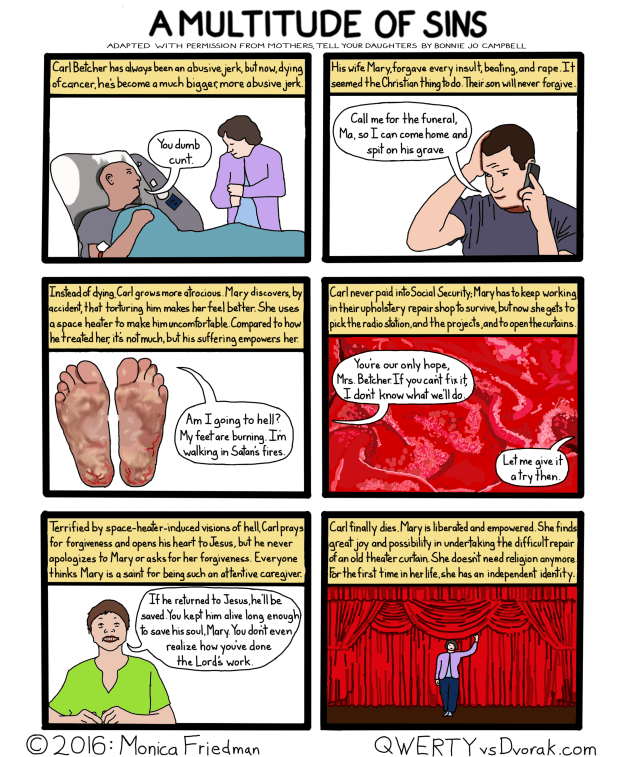
Those are some extremely nasty feet.

Admittedly, the interpretation, “She doesn’t need religion anymore,” has been filtered through my experience, but this is the only story in the book that really depends on religious references to forward the plot*, and it doesn’t look good for Christianity. The idea that a man could spend an entire marriage physically, emotionally, verbally, and sexually abusing his wife, and then be worthy of heaven because his fear of the flames of hell caused him to seek Jesus while lying delirious in his deathbed, is sort of deplorable to me. I know plenty of Christians who believe the way to heaven is good works, and that people of any denomination will be rewarded if they live righteous lives, but I probably know more who cry and pray over perfectly wonderful human beings who don’t happen to be saved, and are therefore damned.

By this metric, the Dalai Lama is damned, but Jeffrey Dahmer is in heaven. Chew on that. Or don’t, if you find jokes about cannibalism in poor taste. Whoops, I did it again. I am also damned. I think Mark Twain summed it up best in Huck Finn when Huck says that if Tom Sawyer isn’t going to heaven, he doesn’t want to go either.

The thing about her identity is unquestionable, though. One really cool technique that Bonnie Jo uses in this story is to offer clues in the form of nomenclature. To wit, in the exposition at the beginning of the story, the main character is referred to as “the wife.” Then, as she starts to react to her situation instead of lying back and taking it, she becomes “Mrs. Betcher.” Finally, at the very end of the story, when she ignores the preacher to work on the fascinating theater curtain (a project her husband would have never allowed her to take for pecuniary reasons) she is “Mary” at last. This may be why Bonnie Jo has been a finalist for the National Book Award, and I have not. But I guess the fact that I can point this out is why I’m drawing these comics, and everyone else is not. I bet I could write a 2000 word essay just on the use of this naming convention in “A Multitude of Sins,” but I guess I’ll leave that to people who write more conventional and less personal literary criticism.

*In some ways the Corinthians quote in “Somewhere Warm” could be the flip side to the terrifying Revelation visions in “A Multitude of Sins,” but religion plays a very different and less prominent role in that story, whereas this one even takes its title from the New Testament.

Natural Disasters

bjc-natural-disasters_edited-2

Status: I’m just drawing a human placenta here. 

The world is a terrible place to bring a child. It’s full not only of sharp and hot objects, but also of dangerous plants, animals, geologic and meteorological phenomenon, and, most corrupting influence of all, human beings. I don’t actually understand how anyone over the age of 30 can even consider it. I get being young and naive and optimistic, or being a kid who doesn’t fully grok birth control, but surely by 30, most reasonable people have become cynics, no matter how much love they have in their hearts. Our world is inherently dangerous, and more so if you happen to be a completely helpless and dependent organism. And yet my Facebook feed is constantly full of babies and sonograms, even though I turn 42 this November and have a number of friends who are grandparents. My cohort keeps creating new humans, on purpose.

I’ve been to parties where people brought gifts of baby products to a pregnant woman, but I’ve never attended one of these weird-baby-themed-games kinds of baby showers. It sounds demeaning for everyone involved. Most likely, anyone who actually knew me would know better than to invite me to such a gathering, but it’s always interesting to see what “normal” people think is normal.

While I share the narrator’s belief that the world is wildly dangerous place, I’m not afraid of babies breaking. I’ve worked with many babies in my life. Babies are actually more resilient than adults in many respects. A lot of new moms seem overly cautious, in my opinion.

Mothers, Tell Your Daughters

bjc mothers tell your daughters_edited-2.png

I’m counting on you, my flesh and blood, to somehow read my mind.

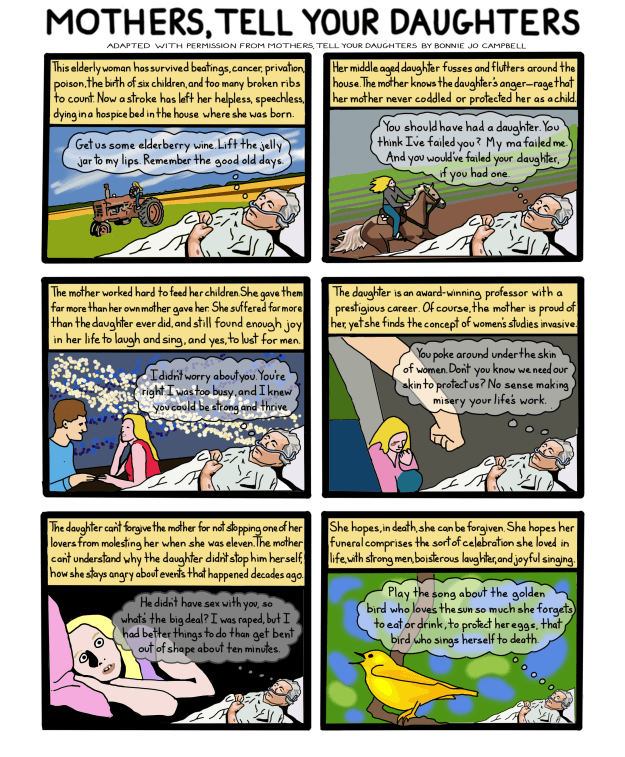
This is the central story of the book, of course, and the one that stayed with me the longest. When I think of this book, I think of this story, and when I first thought of starting this project, this is the story that came to mind. So I’ve been thinking about how I would portray it for a long time. Still, it always changes once I start working.

Originally I thought the middle aged daughter would appear in the background, along with the house, and the memories would be small elements, but the memories sort of loom larger and larger; this woman only has the past. And then I didn’t draw the middle aged daughter at all, because the mother hardly sees her. I mean, she feels her anger, she watches her, but she doesn’t see her child. She’s busy justifying herself.


Somewhere Warm


bjc somewhere warm_edited-2

In Dad’s defense, I also fled Kalamazoo for the southwest. Those winters were killing me. 

Believe it or not, this comic took longer to draw that any of the others. I must have drawn the girl’s face in panel 3 about 50 times. Same with panel 5, and the mom never came out quite the way I wanted. Panels 2 and 4 are perfect, though. That’s my biggest obstacle drawing comics. I can usually draw one character the way I want them to look 1 time. But drawing the same character over and over, with different expressions and postures, from different angles, and make them still appear to be the same character feels impossible. I need a life drawing class. Or a bunch of live models.

I left the clothes and skin intentionally blank so as not to detract from the girls’ freckles.

It’s kind of a sad story. The mom just starts to thrive on being alone when the kid comes back, and the kid coming back is going to be a massive burden on her. The mom doesn’t exactly change as a character, although she does grow. It’s sort of like she’s choosing to stay the course, even though she never gets the outcomes she expects, but the growth is in her understanding that some people are just awful. At least, in the future, she’ll understand that she’s pouring her love into an open sewer. I mean, I guess the baby can be seen as a chance at redemption, like maybe this time, if she just loves enough, the baby won’t grow up and leave her. But personally, I sort of think she’s going to keep getting the same outcome. The fact of the matter is, if she ever met a man who she didn’t drive away with her creepy, cloying talk, he would suck her dry.

My Sister Is in Pain

bjc my sister is in pain_edited-2

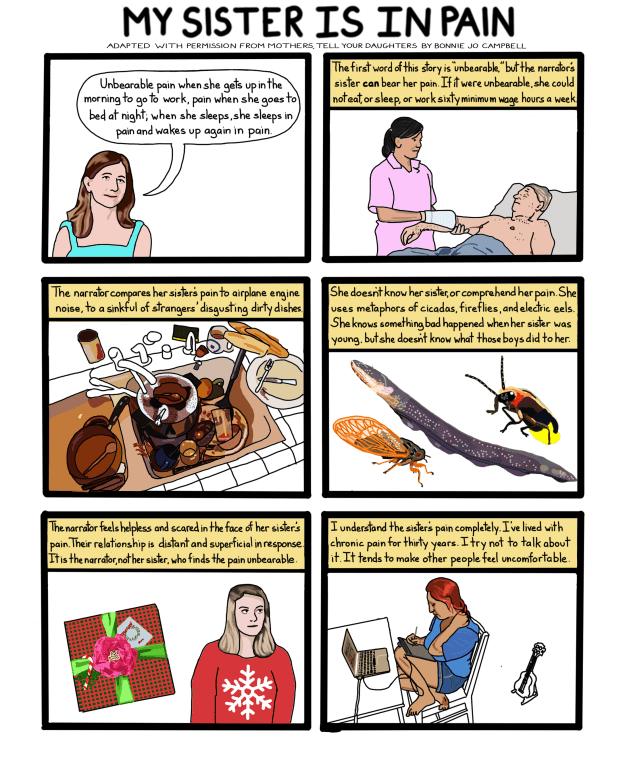
I’m afraid some people will find panel 3’s realistic depiction of a sink full of disgusting dishes perhaps a little bit triggering. 

This is rather a personal subject for me, but Bonnie Jo keeps referring to these comics as literary criticism, and, the human brain being what it is, it’s impossible for a critic to not inject themselves into their interpretation. So I drew my own sister in panel 1, and myself in panel 6. That’s the real reason I didn’t draw this one last night: it’s not a comfortable subject to dwell on. A sighted person can never understand what it’s like to be blind, and a person without chronic pain can never understand what it’s like to live with chronic pain.

And I guess a person with chronic pain can never understand what it’s like for their loved ones to cope with their chronic pain. But this story explains it pretty well.

This is probably the most detailed BJC comic so far, illustration-wise. Everyone’s hair is on point. I went insane withe those dirty dishes. It helped that I started early and didn’t stress out. A couple hours in, the Bear called me up and he ended up coming over to hang out. I can’t think of how many nights I spent at his place watching him work, so he didn’t mind watching me, and he was very helpful in taking the source photo for the last panel. Usually I spent 15 minutes setting up the shot–a lot of time spent finding the right height for the camera, and a thing to hold it at that height–and then have to take a dozen photos to get the picture. But his help eliminated the setup, and he got the shot on the second picture. Artists helping artists.

Children of Transylvania, 1983

bjc transylvania_edited-2

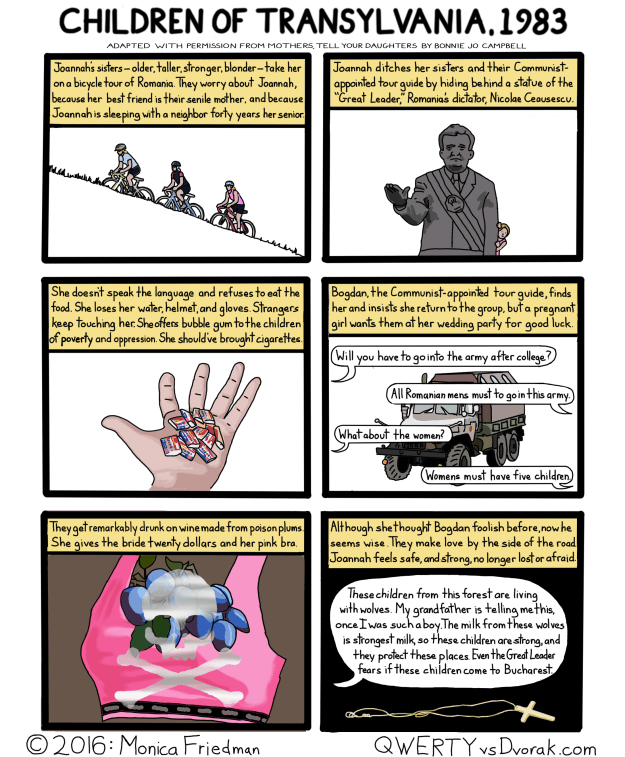
Poor children in Communist Romania were crazy for Bazooka Joe. Who knew?

“Children of Transylvania, 1983” is one of the richest stories in this book. So many strange and beautiful images had to be excised to fit the format, and so much of the plot. Admittedly, when I first read this story, I was kind of impatient with the protagonist’s unfortunate decision-making skills, but taking the piece apart to do this comic, I fell in love with her journey on a more complex level.

But I had to leave so much out! All the details about her encounters with the various Romanians she meets. The part where all the girls ask her for birth control. The food, the water, the milk. Every reference to Count Dracula. Still, it came out much better than I thought it would.

You know what’s hard to find? A source image for a Communist era statue of Nicolae Ceausescu. Right away, I realized why: unlike the rest of the Communist revolutions that happened in 1989, Romania’s was violent and bloody. People died, they gave Ceausescu a 1-hour trial in a kangaroo court, and then they took him out back and shot him. And then they went and smashed the ever loving essence out of all the Communist statues. Both tourism and cameras were limited in Romania at the time, ergo: people have not made a priority of uploading photos of Ceausescu statues to the internet. Almost every picture is of his statue planted face first on the ground, after the people toppled it over.

That’s a pretty cool skull and crossbones spray painted over a sports bra bursting with ripe plums in panel 5, I must say.