Tag Archives: fiction

A Shonda for the Vays Menschen

I've seen some stuff, you know?

I’ve seen some stuff, you know?

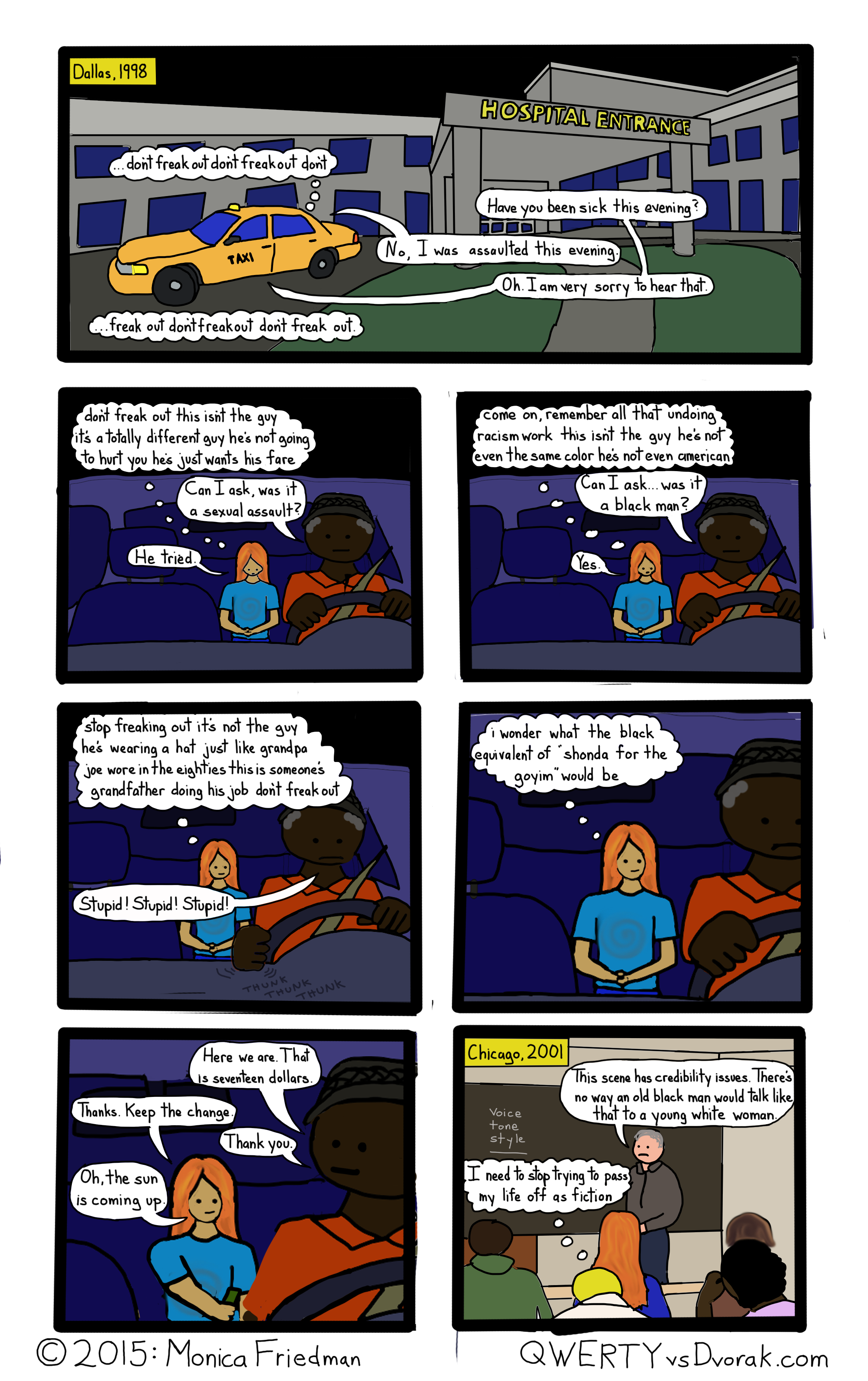
It’s all true, anyway. An African cab driver really did ask me if I was raped, and a bitter, critical, English professor really did tell me that there was no way that could ever happen when I tried to tell the story in an undergraduate fiction writing workshop. I suppose that’s a big difference between fiction and non-fiction. Readers just won’t accept certain types of events in fiction: you can’t write too many tragedies into a story, or too many coincidences, even though strings of tragedies and coincidences of course happen in real life.

We’re used to reading clean dialog, too, and heaven knows people don’t really speak the way their words appear in books. People say “um” and “ah” and “like,” and they stutters and repeat themselves in a way that would be utterly annoying to read. Fiction isn’t like life, after all. Fiction wraps up. There are metaphors and meanings. Life is messy and crises don’t always happen for a reason, and people don’t always learn from them.

A “shonda for the goyim” is a Yiddish sentiment, which expresses that a Jewish person has done something shameful in the sight of non-Jews, which will then reflect badly on all Jews, because anti-Semitism. I’ve since been told that black people would say, “a scandal for white people,” or something to that effect. I had mixed feelings about having an entire panel depend on a phrase in a foreign language, but that’s really what was going on in my head, too, and I think it reflects an important parallel, the kind of point upon which fiction depends, but which life often fails to deliver.

When I was looking up how to say “white people” in Yiddish for the title (I hope vays menschen is correct; I known “menschen” is “people” and if “vays” is pronounced like the German word “weiss”  then it makes sense) I came across a couple articles asking if the Yiddish word “schvartze” was considered racist. Schvartze is the word that some elderly Jews used to refer to black people, and let me tell you, it’s racist as hell. At least it was when my late grandmother said it, usually in the context of, “Lock the doors, there’s schvartze everywhere.” And that’s what I was taught about black people as a child.

I could pretend otherwise, but it’s the truth, and that’s what fiction and nonfiction have to have in common.

Every Person’s Life Is Worth a Story

You're not the only one. No one's *ever* the only one.

You’re not the only one. No one’s *ever* the only one.

Even though my first passion was always fiction, and my training is entirely in fiction, my professional success has almost always been in nonfiction. I don’t know if I’m substantially better at nonfiction than fiction, but people seem much more willing to pay me to tell the truth than to make things up. Since I started workshopping with the Owl and the Rabbit, I’ve spent a lot of time thinking about creative nonfiction, specifically, how memoirs work. People want to tell their stories,and they seem to want me to help them do it.

So: that’s it. Whatever is the worst, the most horrible thing that you feel sort of uncomfortable discussing with even your closest friends, the thing that you would never want the world to know, that’s the stuff you have to mine up from the depths of your brain and polish into a princess-cut gem if you want to write a biography that works.

Why?

People ask that question sometimes, too, and the answer is because you lived through it, and if you did, someone else did too, and your story will validate them, or else someone else is wondering if they can live through it, and your story will give them hope, or else someone else can’t possibly imagine what you’ve been through, and your story will enlighten them. Surviving difficult, confusing, and/or embarrassing circumstances often provides you with the wisdom of experience, which you may then feel compelled to share for the edification of others. This is why we have literature.

All the stories in this comic are true. The one in panel 2 is, of course, the famous “No Wire Hangars” scene from Mommy Dearest, but the others are all details that other people have told me about their own lives, or their parents’ lives, with maybe a couple of my own stories mixed in. I didn’t draw any of the people the way they actually look, though, because while some of these are things that people might not want connected with their identities. (Except for the dog; that’s really what the dog that saved a woman’s life looks like, because come on, that dog is clearly awesome.) I did write earlier in the week that I was planning “one of those brutal personal comics about the most painful things that have ever happened to me” but I couldn’t settle on which brutal, personal episode of my life to wrench up from the darkness, so I chose an assortment of other people’s problems.

I had also planned for this one to have the most awesome artwork yet. I had it all storyboarded out and did the lettering in the early afternoon, but then I forgot about Parent’s Night at the Boy’s school, after which The Man talked me into started the director’s cut of Yentl at 9 pm, so I didn’t get back to work until after 11:30, so I just jammed through drawing all those people. Next week I’ll get more brutal.

Rejection Collection

Jack also collects life experiences, but he can't sell those. Not in this market, anyway.

Jack also collects life experiences, but he can’t sell those. Not in this market, anyway.

Almost 1000 people clicked on Friday’s PTSD comic; of course my best reception would be for the worst things that have ever happened to me. I’m thrilled that it resonated with so many people, but it also re-traumatized me to write it. I thought maybe today’s comic could be a little bit more upbeat. Just a little

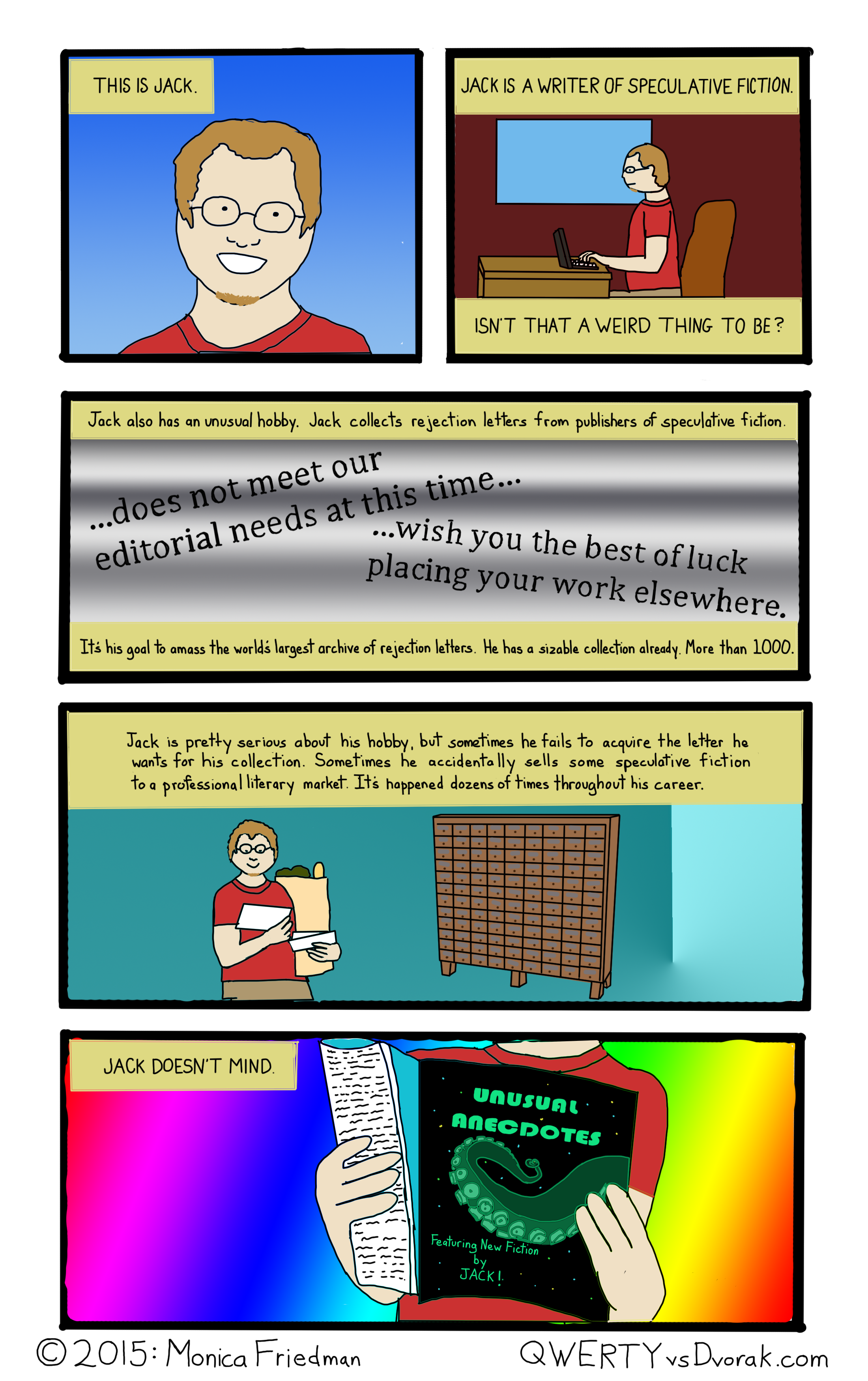
Jack is not the only person who frames his quest for acceptance by asking to be rejected. There’s some science there about giving yourself permission to fail in order to work your way into succeeding. There’s strong research on this, and yet it’s still kind of a hard concept to embrace.

Personally, I’m terrible at dealing with rejection. I have too many negative childhood memories of being rejected. Asking for more rejection when I’ve finally gotten to a point where it doesn’t happen otherwise feels dangerous.My collection of “Thanks but no thanks” letter from publishers is substantially smaller than Jack’s and so is my “works published” list. Jack is a good inspiration, but it’s hard to keep up with him sometimes. Still, that’s what it takes, sometimes: a relentless pursuit of ones goals.

In addition to a massive collection of rejection letters and a substantial list of published stories, Jack also owns an old card catalog, or at least he’s the custodian of this unwieldy but awesome piece of furniture, for which I also envy him.

If there’s not a spec fic magazine called Unusual Anecdotes, there should be.