Tag Archives: fourth wall

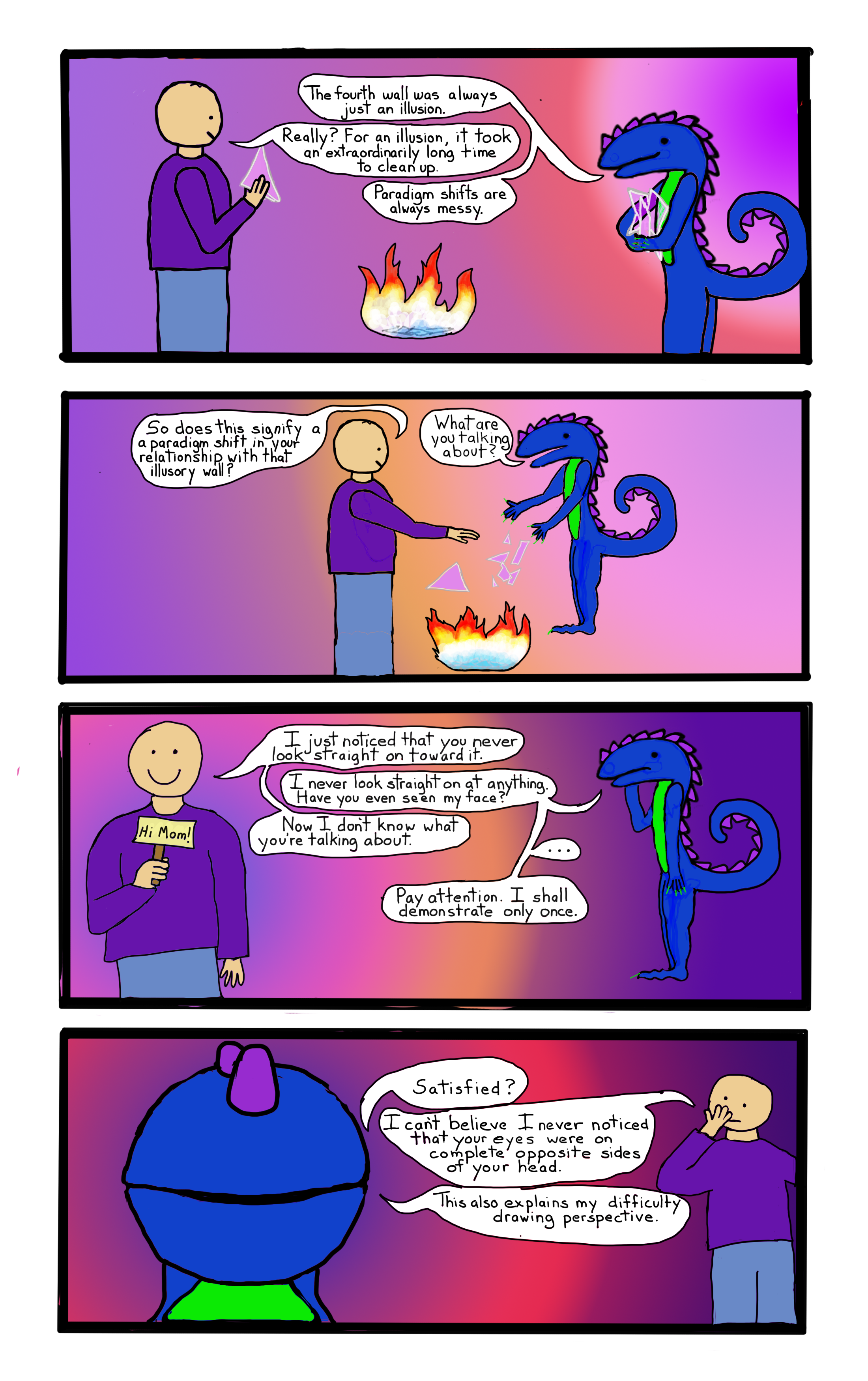
Dragon Comics 33

I suspected this would become a problem early on, no matter how great Dragon looks in profile.

Professional comic artists, people who draw better than I do but perhaps not quite as well as they’d like, typically maintain massive clip files of art, so that they always have references for whatever pose or setting they’d like to draw. Fine artists usually spend a lot of time with live models, again providing them with extensive data on which they can depend when sketching. At the very least, many artists make use of articulated wooden models, which help them understand how the human body is put together and able to move. Barring that, today, if you’ve got a good connection and basic Google-fu, there’s a decent chance that you can find a photographic example of whatever’s inside your mind, if what you want is a fairly common thing from a fairly ordinary perspective.

Even so, you can’t find everything. Certain angles are just not represented in GIS. For example, in Dragon Comic 29, panel 3, I knew that I wanted to draw The Man squatting as he picked Dragon, and I was easily able to find many visual examples of this pose online, but most of them were intended as instruction for athletes, and for educational purposes shot either straight on from the front, or slightly angled from the side. There weren’t as many direct shots from the side, which is what I needed, so I had to extrapolate. And even so, The Man still curves his back in a non-ergonomic fashion. I image that he straightened out before he began lifting, so as not to hurt himself. He’s bigger than Dragon, but Dragon’s no featherweight, either.

Sometimes, I take pictures of myself in certain poses to help me see how to draw them. The more comics I draw, the less I have to do this.

The thing I couldn’t imagine, or Google, or photograph, of course, was my main character’s head. I could guess how it might look straight on, but I couldn’t be certain because there’s no frame of reference and my relationship with perspective is tricky. When I had the idea for comic 33, I needed a way to double check that what existed in my mind made sense in the reality of the comic, which I will discuss in tomorrow’s post. Like the smashing of the fourth wall, I think this new technique in my arsenal will help add more dimension to what the rabbit correctly asserted is a rather two-dimensional set of illustrations.
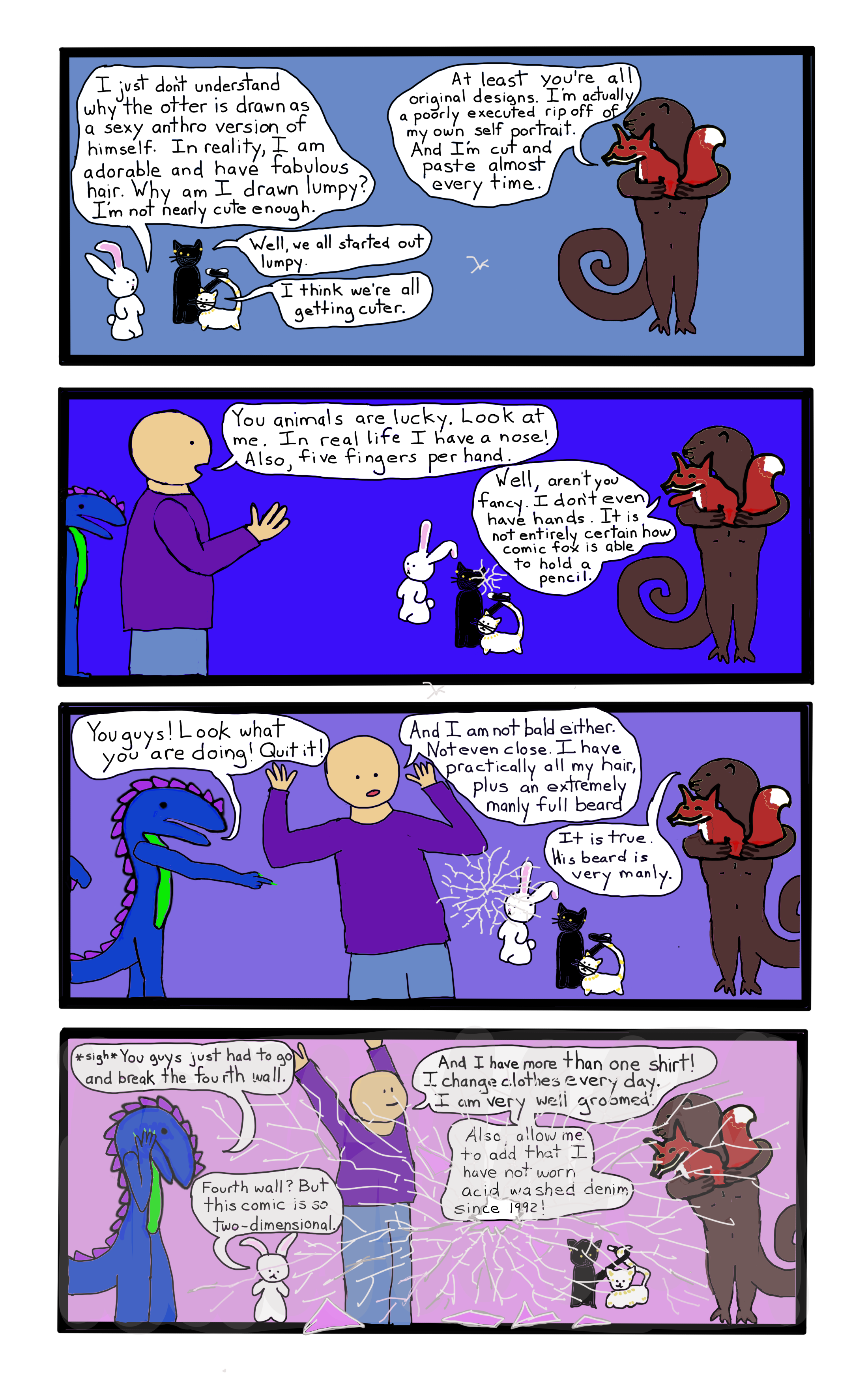


Dragon Comics 31

This is something I’ve been looking forward to doing for weeks and weeks, almost since I started drawing Dragon Comics. Are you not amused?

In my defense, the rabbit is definitely getting cuter. And cut and paste is easier than trying to make the characters looks like the same characters every time.

In my defense, the rabbit is definitely getting cuter. And cut and paste is easier than trying to make the characters looks like the same characters every time.

More or less, I was basically able to recreate what appeared in my mind when the idea came to me, which is progress. Still not perfect, but the main idea is communicated by the illustration, I think. I’m fairly pleased with the shattered glass effect in panel 4. It could use some more work, but, once again, the witching hour is at hand and the terms of my agreement with myself say that the comic goes up, perfection be damned.

This kind of playing with meta perspective pleases me greatly, and it’s so well-suited to comics and cartoons. Probably the most extreme and well-known example of 4th wall breaking in animation would be the 1953 Chuck Jones Looney Tunes classic, “Duck Amuck,” in which the animator spends 7 minutes torturing Daffy Duck with inappropriate scenery changes, repeatedly erases him with a giant pencil wielded by an unseen hand, and, since this cartoon relies heavily on the viewer’s knowledge of trope, replaces an (open, functioning) parachute with an anvil. There’s always got to be an anvil. For an added bonus, the sketch ends by doubling the self-referential nature of the narrative while pushing it firmly back into place by revealing that the sadistic cartoonist is actually Bugs Bunny, screwing with his old nemesis Daffy. After establishing a refreshing commentary that reflects the separate world (reality) influencing the cartoon, the end sequence encloses the entire story back in the cartoon world.

I could never be so cruel to my characters who, as you may realize, represent my actual loved ones, none of whom have even tried to convince a hunter that it was Dragon season. I just like to play. In fact, as I get older, that kind of classic cartoon violence-for-the-sake-of-violence makes me more and more uncomfortable. Apparently, some of us become gentler with age. That kid of cartoon violence is funny. It’s just not fair. I would rather wait 3 seasons to watch Aang spend 8 minutes fighting Firelord  Ozai before defeating him with compassionate nonviolence than see any number of falling anvils. Don’t get me wrong; falling anvils are still hilarious. Epic storytelling is just more fun.

Please note that even after the fourth wall has been completely shattered, The Man goes right on breaking it. He’s funny like that.