
For once, I take no credit for the messed up things that happen in this comic.
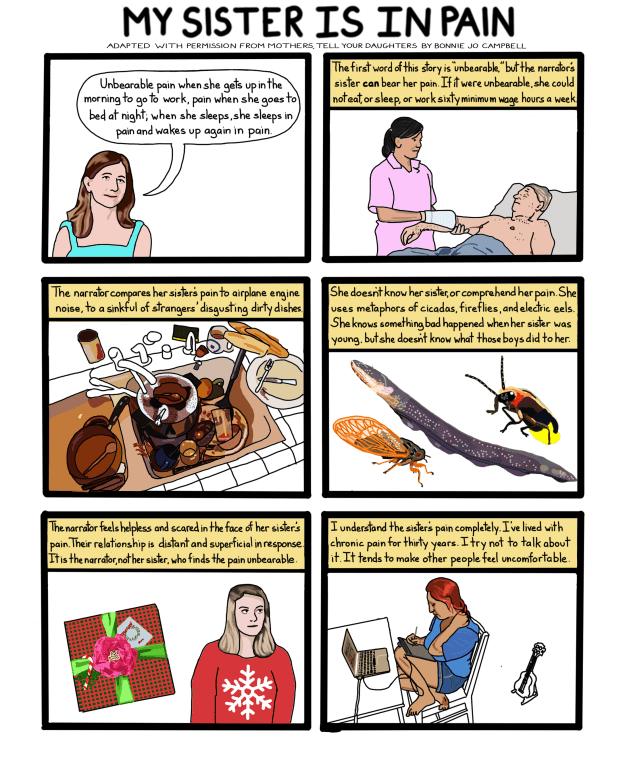
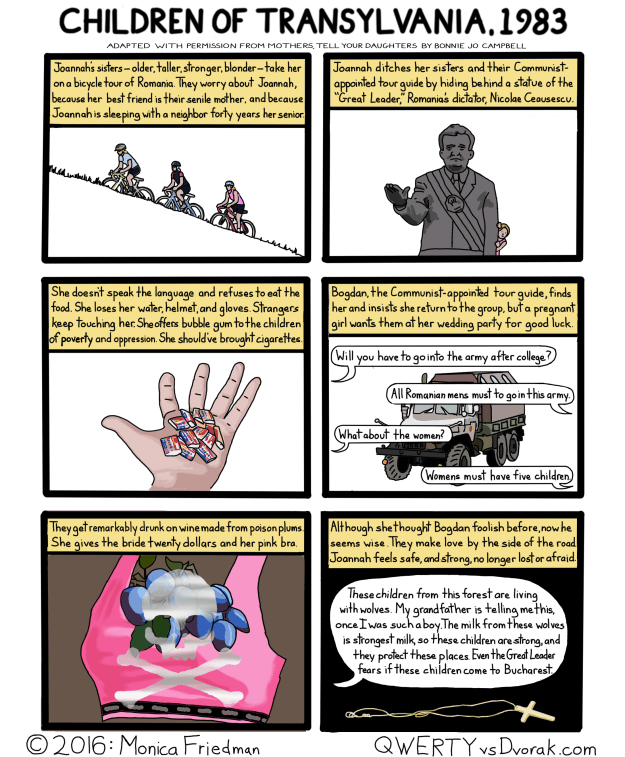
At long last, the wait is over. Here is the first Bonnie Jo Campbell Mothers, Tell Your Daughters comic.
For those coming in late, after I drew my comic about Bonnie Jo’s mother, some of her legions of admiring fans said they wanted to see her entire most recent book made into a series of comics in that style–6 panels summarizing an entire story–and Bonnie Jo said she would like to see that, too. And part of me was like: who am I to say no to this opportunity? And part of me was like: who am I to say yes to this opportunity?
It was a daunting task. You can’t say much in 6 panels, and Bonnie Jo’s work is so complex and nuanced, both in its use of language and its understanding of human nature. And the thing is, I absolutely knew that I had the ability to do it. If not me, who? But I also doubted my ability. I kicked around ideas. I pondered and perseverated. I realized that I didn’t own a corrected copy of the book, just the ARC, which Bonnie Jo had explicitly told reviewers never, ever to cite, and also to burn, which you know I didn’t do. But I did request the complete manuscript, which she kindly sent.
Then, overwhelmed, I failed to decide where to begin. Originally I thought it should be the eponymous “Mothers, Tell Your Daughters,” which, in some ways, I think is the most powerful story in the book, but it’s also 20 pages long, and my brain wasn’t prepared to wrap around that yet. Then I thought I should start at the beginning, but it happens that I have a particular relationship with the first story in the book, dating back to more than a decade before the book was published, and, in keeping with the original comic, I knew that if I did that one, I would have to tell my story about the story, rather than the story itself. And that didn’t seem the way to begin either. If anything, that comic would come at the end of the project.
“My Dog Roscoe,” like most of Bonnie Jo’s work, and also like Bonnie Jo herself, has this sort of electric undercurrent of humor. The concept is ridiculous. You want to shake this character and explain to her what’s actually going on, but you can’t, and to the character, the scenario is life and death serious. That’s another thing I love about Bonnie Jo’s work. She writes about people who either have the worst luck or make the worst decisions or were just born into the worst circumstances (or some combination of all 3), but there’s still something funny about their misfortune. There’s this story in American Salvage where this guy is having an increasingly terrible night (mostly because he makes terrible decisions, because, like the woman in “My Dog Roscoe,” he’s missing some key information about himself) and he literally douses himself in gasoline and sets himself on fire by accident. And it’s terrible. He’s badly burned. But you’re also still laughing a little bit.
Comically tragic.
Maybe that’s just me. Maybe I’m a terrible person. Maybe nobody else thought it was funny when that dude accidentally set himself on fire because he didn’t understand women or the rules of safety at the pump.
Then again, if it’s just me, then why does this work so well as a comic?
Also today, I was thrilled to note that my work was used (with attribution and backlinks) in a post about Venezuelan idiom on a language blog. It’s an Australian website. I think the Australian idiom would be “chuffed.” I am chuffed to see my work travel and see the world.
 qwertyvsdvorak