
Jacks, my little hero. From the unpublished novel The Girl Who Followed Her Own Counsel. Drawn sometime in the late 90s.
It took me 17 years to write the first draft of my first novel, and while the storytelling came hard, the characterization and world-building came easy. I lived in that world for years, and it’s an easy one to go back to. I believe I did sketch out at the major city at least once, but it was a picture drawn from memory; I didn’t need or use it as a reference, because I knew exactly where everything was. I knew it so well that when I wrote the sequel, I still didn’t need the map, even though the characters spent time the other side of town, where Jacks rarely ventured in the first book. I wish I still had that map, but I have a feeling it’s long-gone; I haven’t seen it in years. Possibly, it was done in a notebook, in which case it might turn up.

Mallory’s mansion, from my 9th unpublished novel, The Hermit, sketched on the back of a library receipt.
Mallory’s mansion was the first time I needed to sketch out a scene I couldn’t hold in my head. It’s a sprawling, one-story adobe, built around a series of inner courtyard gardens, and this drawing helped me keep the protagonists’ progress through the building straight in my mind. Kaija, the eponymous hermit of the novel, knows the building well, but she hasn’t been there in years. Mallory has passed away, and Kaija and her friend, Little Brother, are systematically searching the rooms for a message they believe Mallory may have left.
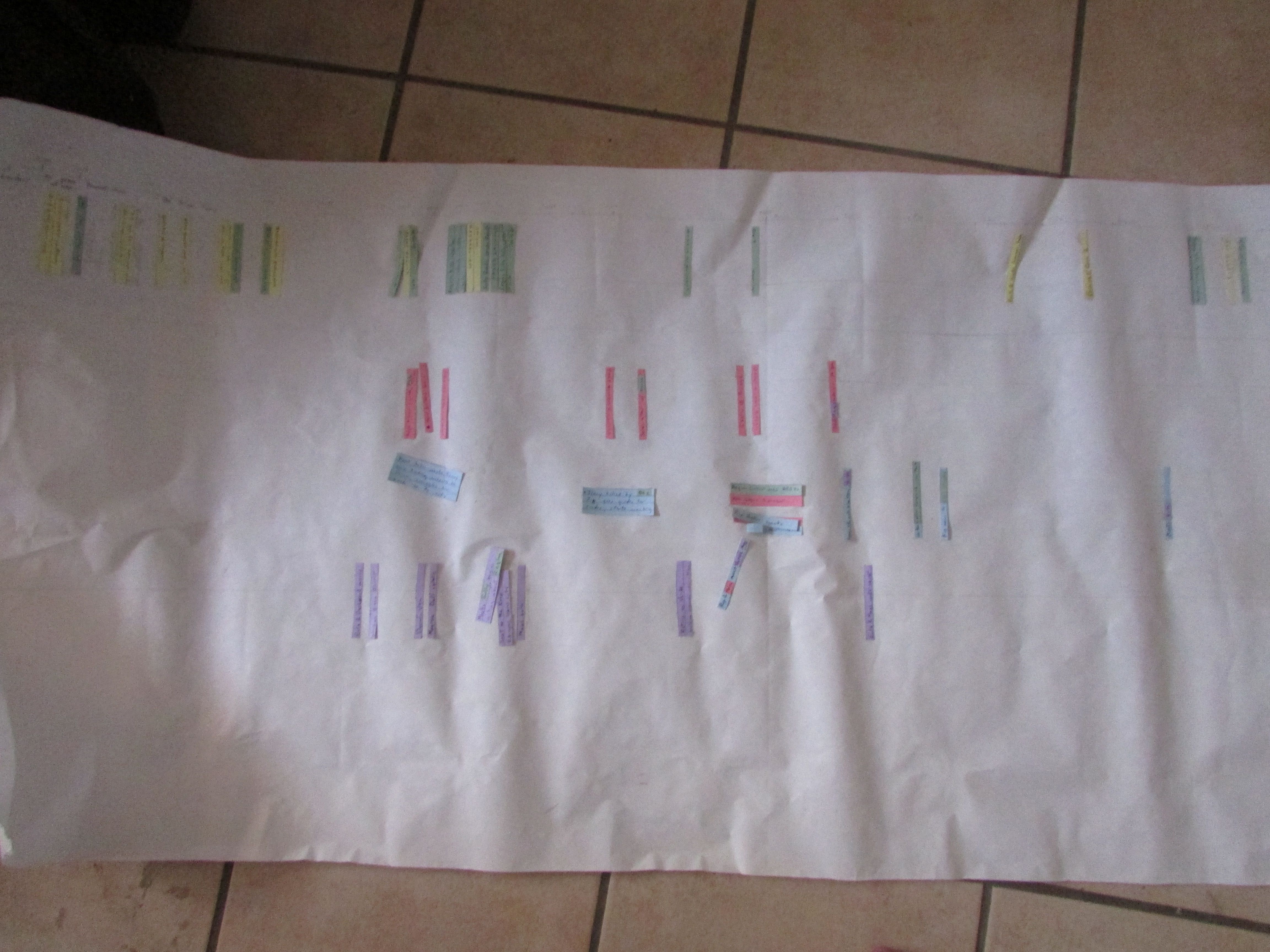
New Pueblo timeline, showing the history of the city and the history of several families, along with the protagonist’s progress, from my 10th unpublished novel, Greenpunk.
When I started Greenpunk, I knew it would be at least as complicated as The Girl Who Followed Her Own Counsel, and also that it wouldn’t be a world I could live in. First of all, it’s a dystopian novel and not as pretty as Jacks’s world, and second, my aging brain can’t handle spending 17 years on a first draft. The 2 years it actually took really wore me out; I still haven’t started revising, because it was so cumbersome to gestate (800 pages!). To keep the details straight, I used 2 visual mnemonic devices: a timeline, and a family tree. The timeline actually starts a hundred years before the novel; it’s a murder mystery, so the backstory needed to be firmly in place before the writing began. I started the timeline before I started the novel, added to it as I became more familiar with the world, and then set it aside about 2/5 of the way through the story, once all the characters had met. At that point, I mostly only consulted it to remember the ancient history, the things that happened before the main characters were born.

The Collier family tree. On the off chance that I ever finish revising and sell this novel, I’ve blotted out the details that are mysteries in the book so as not to accidentally ruin the surprise. If it ever comes to that. I don’t think it’s possible to actually read the timeline above, so I didn’t bother editing that, although it’s full of spoilers.
The Collier family tree was a document I consulted frequently as I wrote. Not only did it help to keep the history of the city’s most illustrious family straight as Rip, my protagonist, began to sort it out himself, it also gave me easy access when I needed to bring in new characters. Looking at this chart, which I drew before I started writing, allowed me to answer questions such as, “Who are so-and-so’s confidantes?” and “Which characters are most likely to rebel against the patriarch?” and “Who dislikes whom?”

Darkest Agola, a child’s fantasy world, set on top of his physical world
I’m excited, because the night before last I drew the above map. The first week of August, I’ll be taking a writing retreat to Flagstaff with another writer, where I hope to draft the entire script for the graphic novel I want to start drawing in the fall. This map helps me envision a lot of the story. My protagonist, Prince, is 10 years old on page 1. He lives on his family’s farm, but he envisions it as a magical world where he can set the rules. The upper right hand corner represents the part of the farm his grandmother sold off before he was born, which is now a suburban cul-de-sac. Obviously, a lot of the story’s conflict takes place at the border between these 2 worlds.
A lot of the writing is done in my head, often long before words get committed to paper. Maps, timelines, and family trees help cement the details so they’re firmly drafted before the actual draft.
 qwertyvsdvorak