Category Archives: Comics

What are you doing, Dragon? Part 2

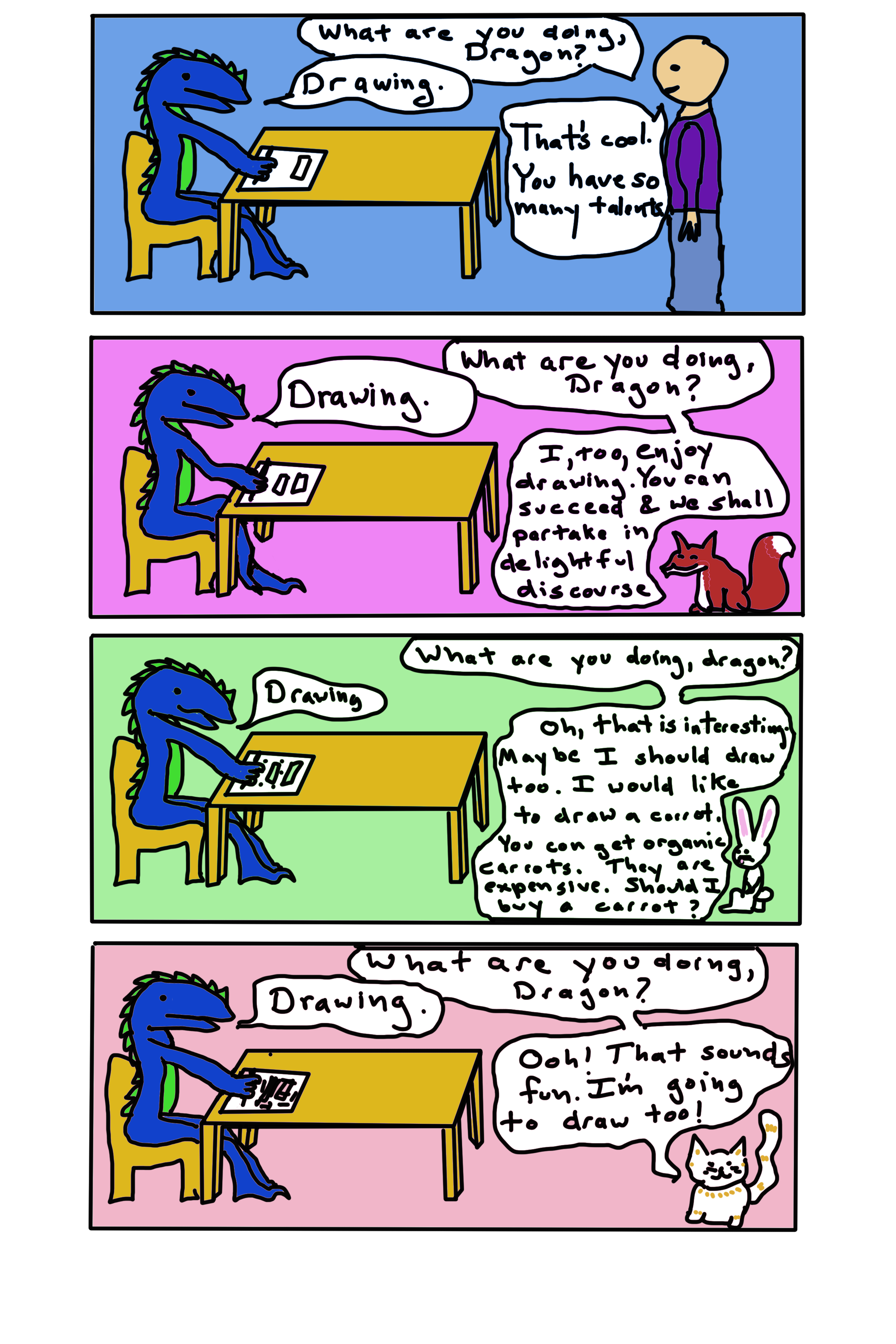
OK, I lied yesterday. This is at least a 3-part comic. Maybe longer. Apparently I can get away with whatever it is I’m doing here, because yesterday was this blog’s best-ever day for page views.

Yeah, the snake's sort of a jerk.

Yeah, the snake’s sort of a jerk. We’ve all met the snake. 

So: conflict! Is Dragon just going to lie down and take this crap? Can she retaliate? Who let that snake in, anyway? Come back tomorrow for more answers. 

What are you doing, Dragon? Part 1

So this is part one of a 2-part comic that I’ve been meaning to draw from QWERTYvsDvorak’s inception. Obviously, I can draw a little bit better than this, even on the tablet, but I wanted to tell the story with a minimum of fuss. There’s something fun about the awful quality of the artwork.

These characters aren’t exactly fictional. I’m pretty sure the people I’m referencing will recognize themselves and hopefully have a decent sense of humor about it. Come back to tomorrow for part 2 of “What are you doing, Dragon?” the question I ask myself. Every. Single. Day.

Can dragon successfully draw? Will these interruptions ever cease? Where's the conflict here? Tune in tomorrow for the exciting conclusion of "What are you doing, Dragon?"

Can dragon successfully draw? Will these interruptions ever cease? Where’s the conflict here? Tune in tomorrow for the exciting conclusion of “What are you doing, Dragon?”


Stories Start with Characters

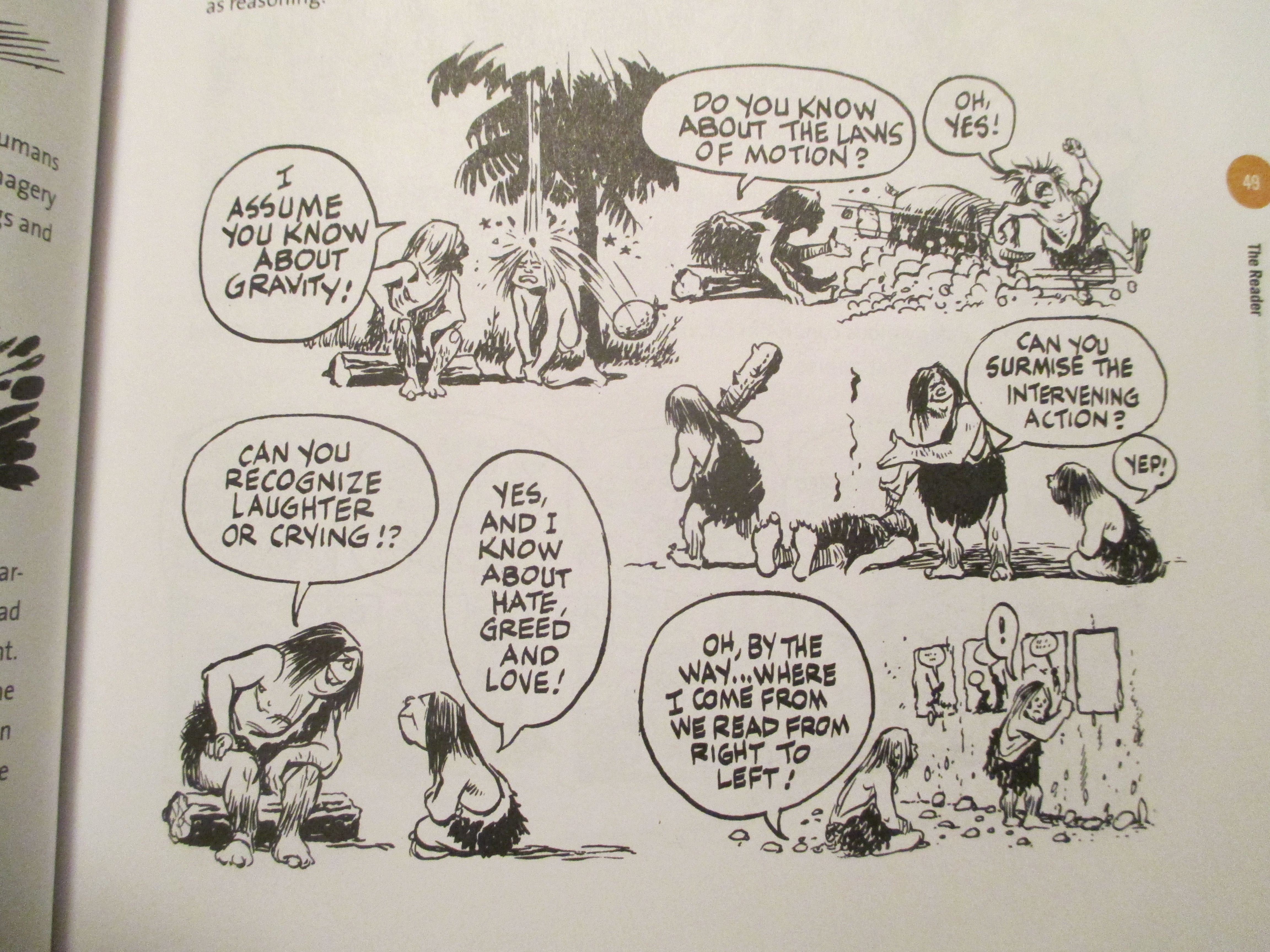
Got 3000 words written today, and hope to get another 1000 before bed. Also finished reading Will Eisner’s Graphic Storytelling and Visual Narrative, which is among the most delightful instructional manuals I’ve ever read. Eisner had an intricate understanding of not only drawing and writing, but of human psychology, and this last was effective to two ends: it allowed him to tell compelling stories about believable people (even if those people were caricatures of regular people, or more amazing than regular people), and it allowed him to tell those stories in such a way that readers remained interested in the work.

Eisner's "Contract" with the Reader

Eisner’s “Contract” with the Reader

Above is one of my favorite panels from this book, illustrating the contract with the reader: the artist may safely assume that the reader lives in the same reality and shares many of the same basic understandings of the world. This allows the art to work as a form of shorthand: i.e., you don’t need to explain to your reader that a coconut released from a tree will descend in the direction of the earth’s core, or that coconuts grow on trees, or that trees drop seeds.

This book has vast quantities of things to recommend it, and even if you’re not interested in drawing or writing or storytelling or human psychology, some of the reprints will certainly be worth your time: Eisner’s beautiful new ending to Franz Kafka’s bleak The Trial, and an example of “compression” by R. Sikoryak comprising Dante’s Inferno retold in 10 Bazooka Joe comics were my favorites.

If you’re here for my art, and particularly if you’re here for my dragons, never fear. I’ve got a couple of compelling characters for you right here:

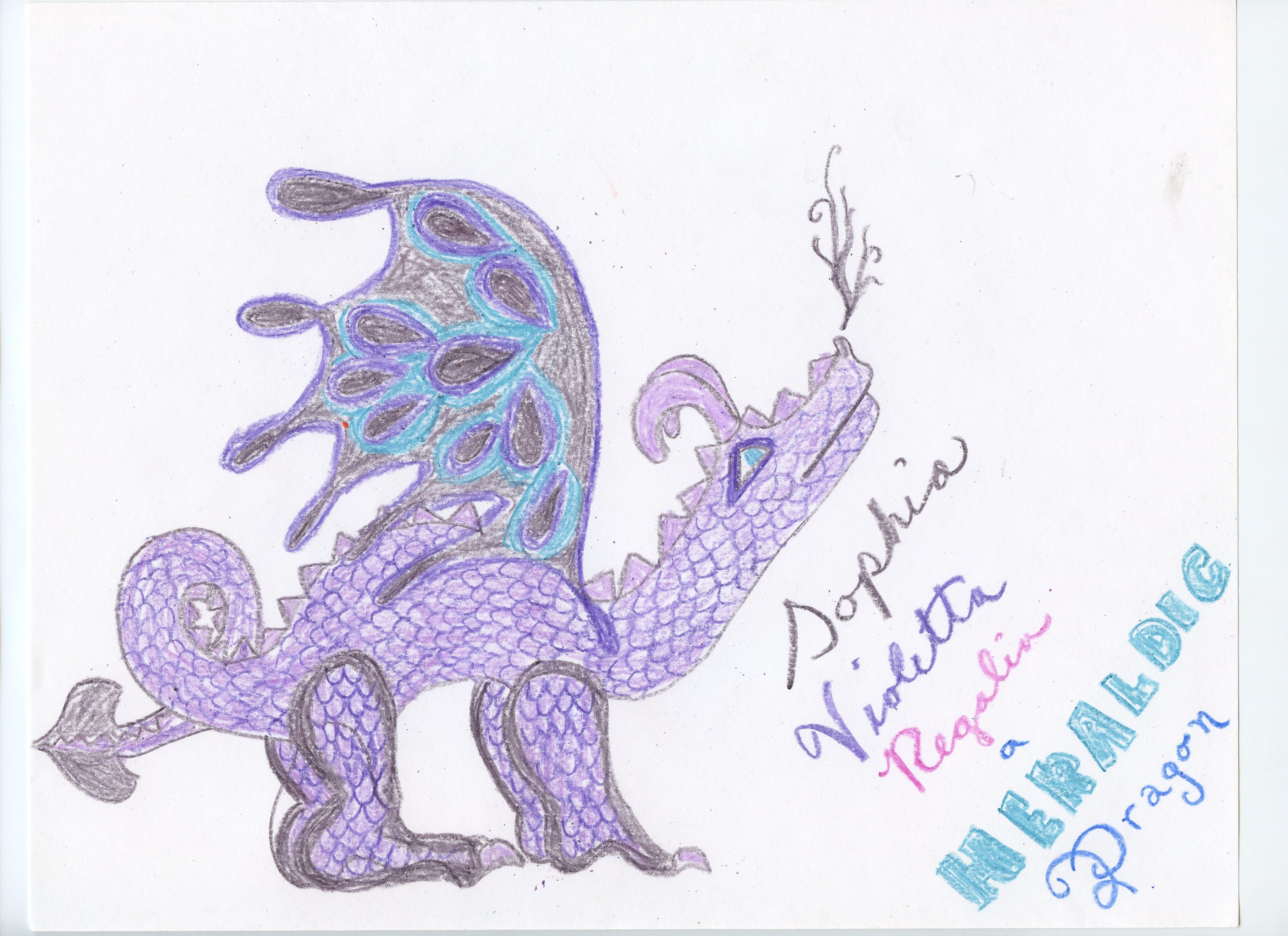
Sophia Violetta Regalia, a heraldic dragon

Sophia Violetta Regalia, a heraldic dragon

Obviously, there need to be as many, if not more, girl dragons than boy dragons.

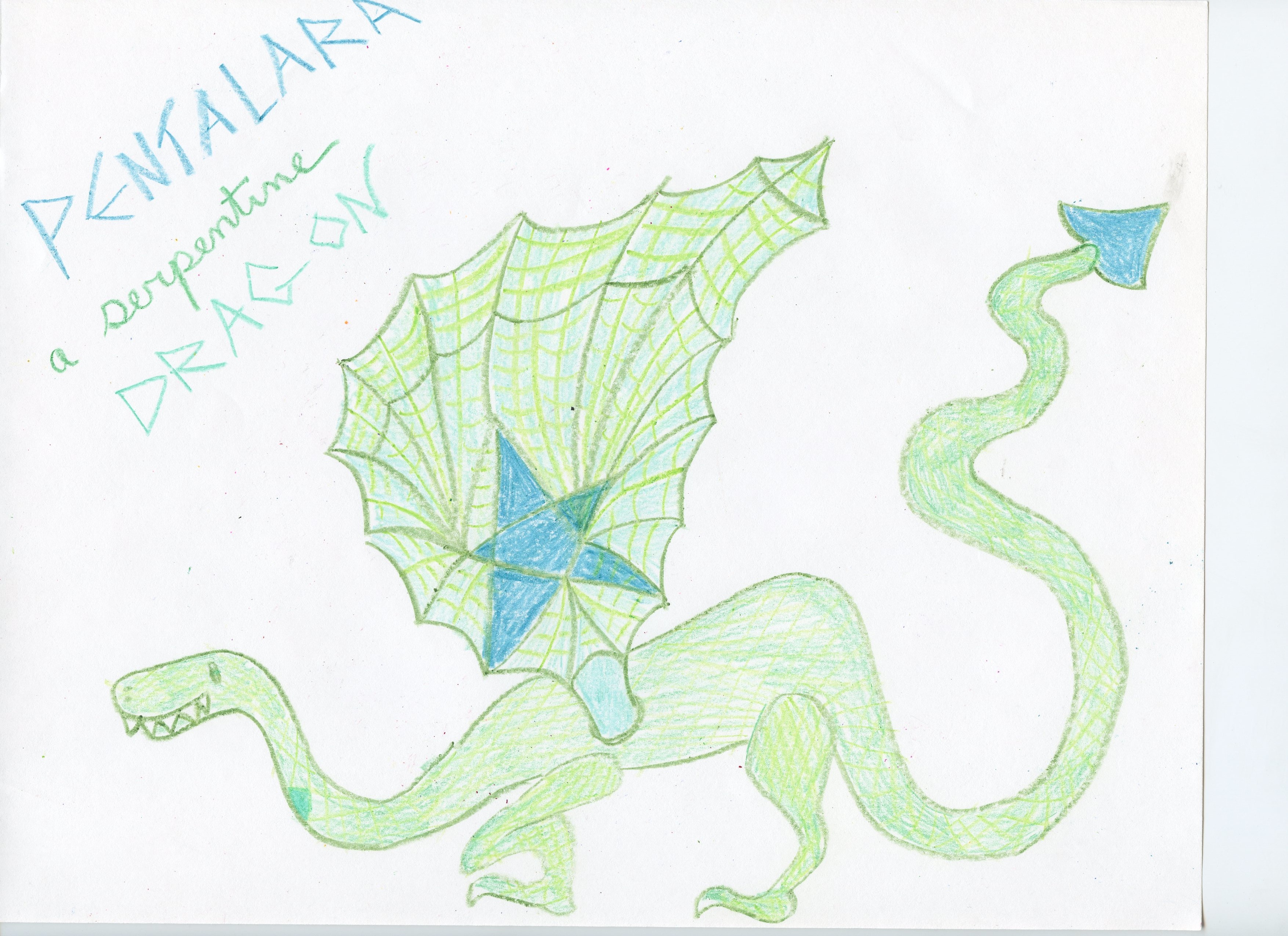
Pentalara, a serpentine dragon who could probably benefit from some orthodontia, if she could find an orthodontist willing to work on a dragon's mouth.

Pentalara, a serpentine dragon who could probably benefit from some orthodontia, if she could find an orthodontist willing to work on a dragon’s mouth.

These lovely ladies certain exude personality.

Drawing about Writing

Living alone, incursions into the writing space were few and far between, but with a family it can be hard to find those broad, uninterrupted swaths of time in which to think of nothing but art. For the last couple years, I’ve had to rely on writing retreats, some taken solo, and some taken with other like-minded artists. Today, I’m on retreat in Flagstaff, working on a new book, and it may not come as a surprise that I’ve decided to try my hand at the graphic novel medium.

Three useful texts

Three useful texts

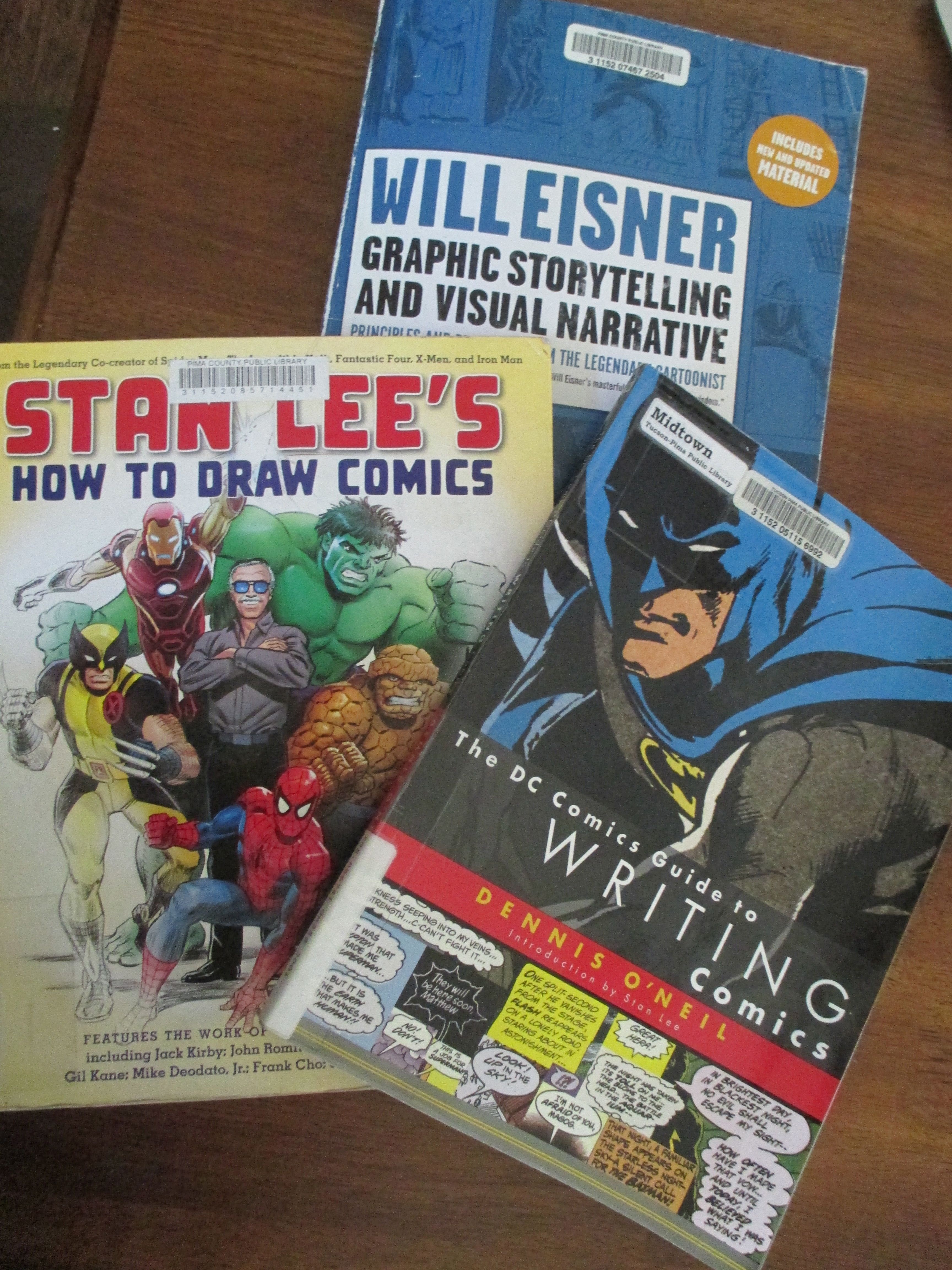
Lacking the time or money for a low-res MFA in graphic storytelling, I’ve been reading voraciously on the subject. The DC Comics Guide to Writing Comics by Dennis O’Neil has by far been the most useful resource on the subject, answering many questions about how to draft a script, and how words and images relate to one another in this format. Stan Lee’s How to Draw Comics is massive and detailed, offering excellent advice for artists. I’m still working on the Will Eisner book; although I’ve not got very far into it, it definitely offers a very different perspective and set of advice. Eisner basically invented the modern graphic novel format.

The Stan Lee book is probably most useful to those who have already learned quite a bit about figure, landscape, and perspective, and just want to know how to translate that into drawing Marvel-style comics. I’m still looking for some old copies of the books that everyone seems to recommend for those wishing to learn more about figure drawing, which are any of the “Dynamic” drawing books written by Burne Hogarth. I could order them from Amazon, but I have $125 credit at a local used book chain, and I’m still hoping to find what I want there, since their stock always changes.

One useful piece of advice from the DC book involves the use of “suggested layout” sketches, normally visual notes from the writer to the artist. While I do intend to do my own penciling, the idea of generating storyboards seems a good way to communicate to myself (the artist) in the future, while visualizing the book to myself (the writer) in the present. These panel mockups may change, but presently, they correspond with the script, which is divided, per Dennis O’Neil’s advice, into pages and panels.
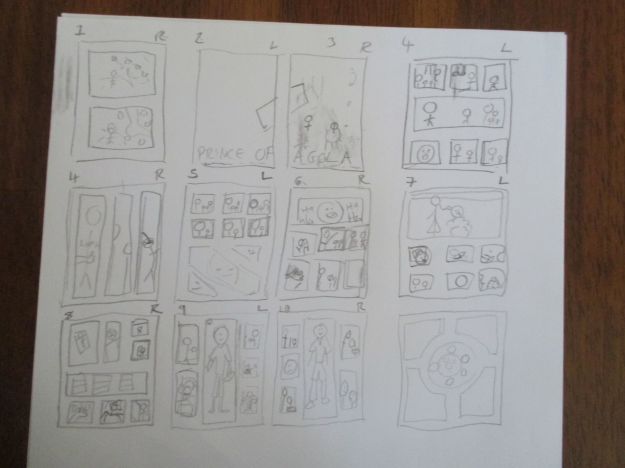
Suggested layouts corresponding to the script

Suggested layouts corresponding to the script

Comics tend to start on the recto, or right hand page. My pages are marked R and L so I can keep rector and verso (left hand page) straight and ensure that 2-page spreads or splash pages, and pages where deliberate mirroring (pages 9 and 10 above) will actually be printed facing one another.

If You Knew the Things up with Which I Must Put

Gourd out of my mind

Gourd out of my mind

The intention in writing a daily blog was to inject a sense of accountability into my art, i.e. the blog would serve as a motivation for creating art every day, depending on the vast backlog of mandalas and dragons for days when life made other plans. It never occurred to me to consider the weeks that life made other plans.

It’s been some dark times at QWERTY vs. Dvorak, but the end (or at least a respite) should be resolving itself shortly.

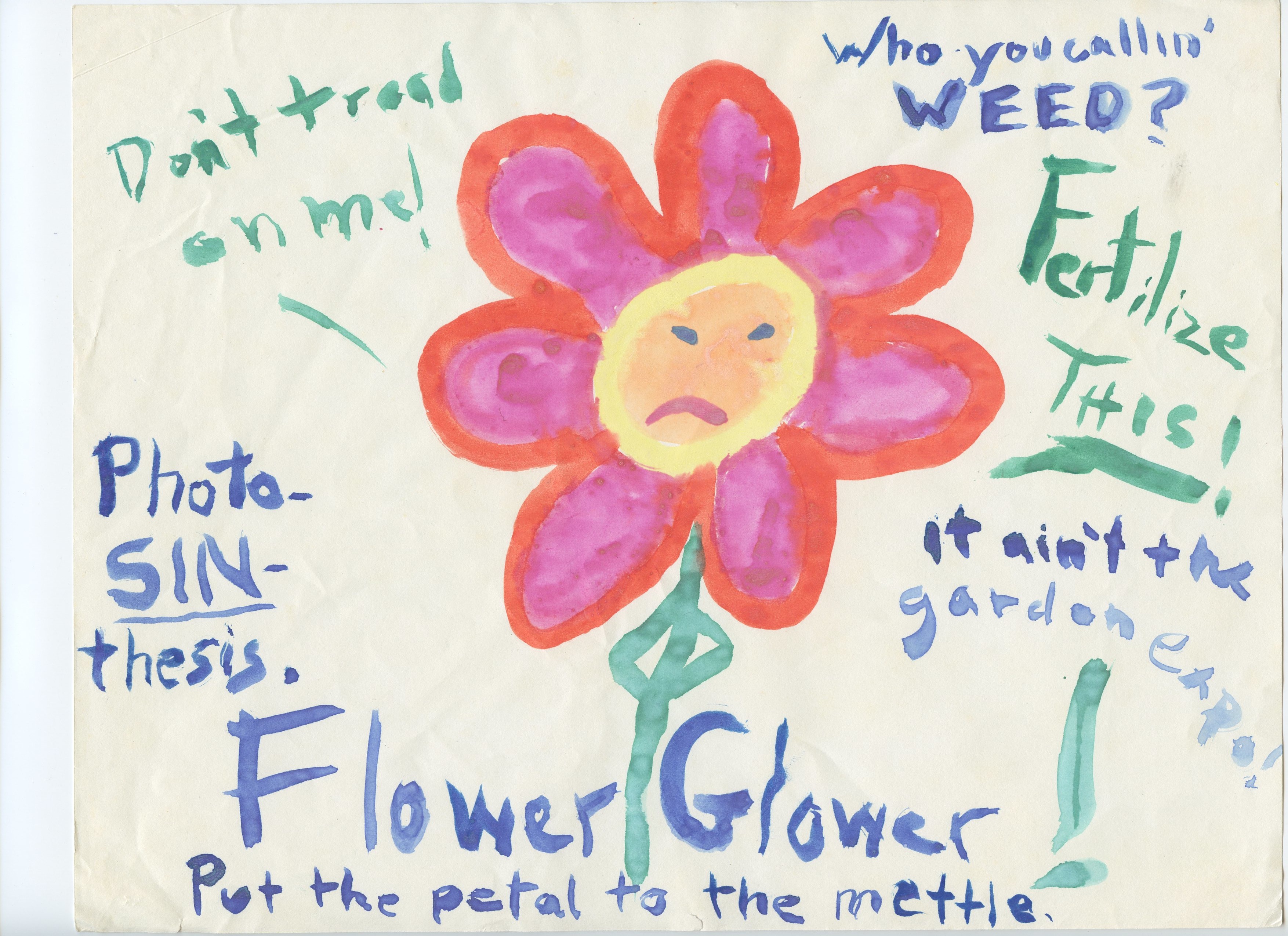
In the meantime, the following crude and unlovely surreal comic from days of yore (late ’90s? early ’00s?) basically sums up my attitude toward life as a partial result of the utter nonsense through which my mind has been dragged this summer.

I am an angry flower.

I am an angry flower.

Technically, this flower could count as a really off-kilter mandala, which is about what you’d expect from a rage-aholic flower.

Too Many Words

There’s a roster of webcomics I adore because they’re smart and funny, and Subnormality, by Winston Rowntree, is high on that list. He subtitles his comic, which mixes fantasy, science fiction, slice of life, and true storytelling, “comix with too many words.

The cursed eyeball plant

The cursed eyeball plant: late 90s

I think I write comics with too many words. I’ve been reading books about graphic storytelling and trying to understand how to create images that do the work of words.

The fiery glowworm; late 90s

The fiery glowworm; late 90s

I drew these comics for my little cousin while toying with the idea of creating an illustrated zoo of imaginary animals, but ultimately, I figured that what came out of the crayons was probably a bit too creepy and esoteric for a 3-year-old.

A clownfish. Why, why, why? This image is so wrong. It was wrong when I drew it in the late 90s, and it's just increasingly wrong every year.

A clownfish. Why, why, why? This image is so wrong. It was wrong when I drew it in the late 90s, and it’s just increasingly wrong every year.

Still working on it.

Big Eyes

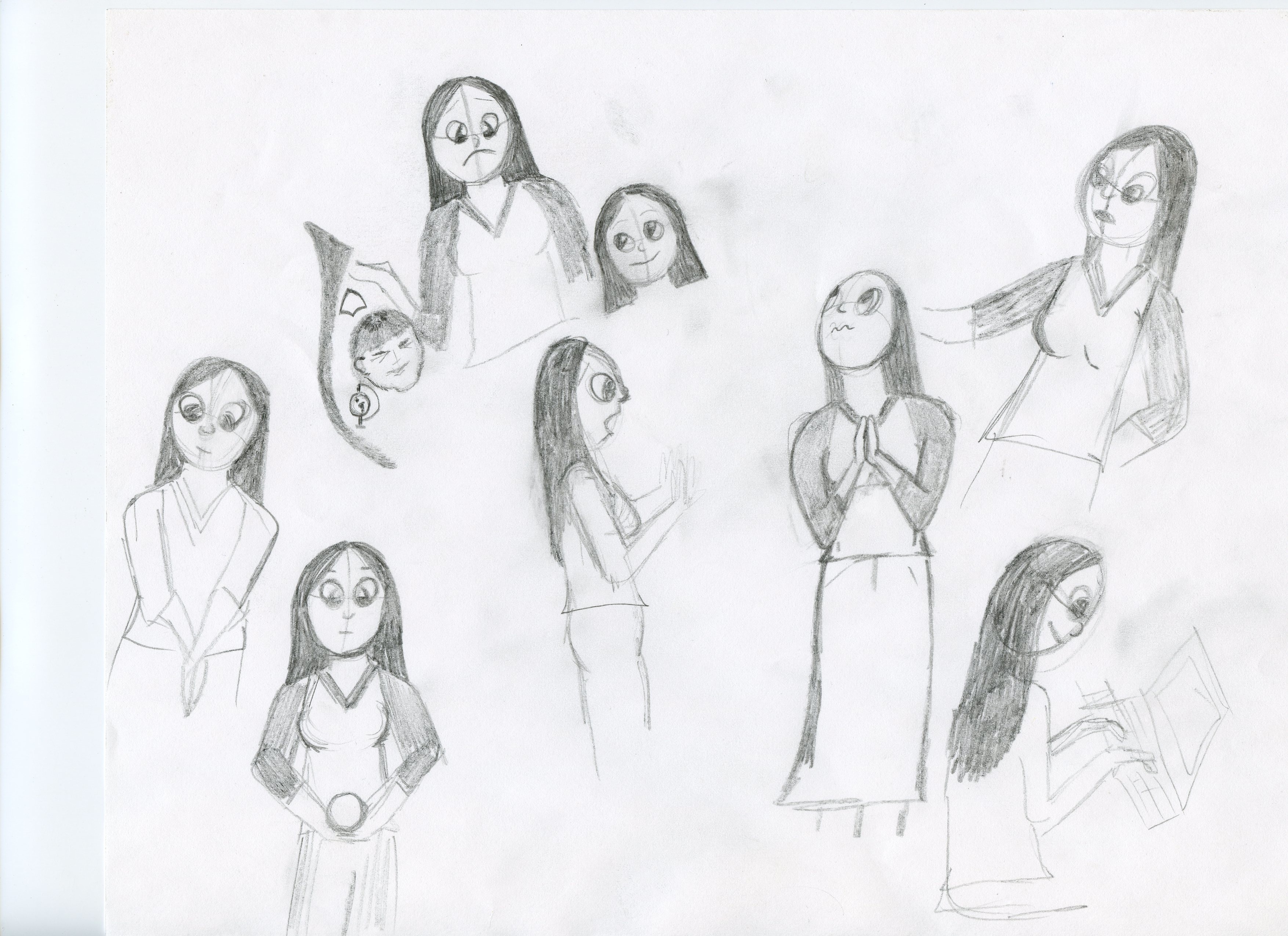
In my quest to develop a style that would allow me to draw a daily webcomic, I experimented with a more anime-inspired face. A lot of cartoonists create these kind of guidelines, so they can see how the characters typically looks in various positions, with various emotions on their faces.

This would be me as an anime girl, I guess

This would be me as an anime girl, I guess.

My problem, as it’s always seemed to me, is that it doesn’t feel as if it’s possible to draw the same character over and over. Does she even look like the same girl? Her face is shaped differently in different pictures. Some cartoonists deal with this issue by drawing every character sort of the same, and just differentiating them through clothing and hairstyles.

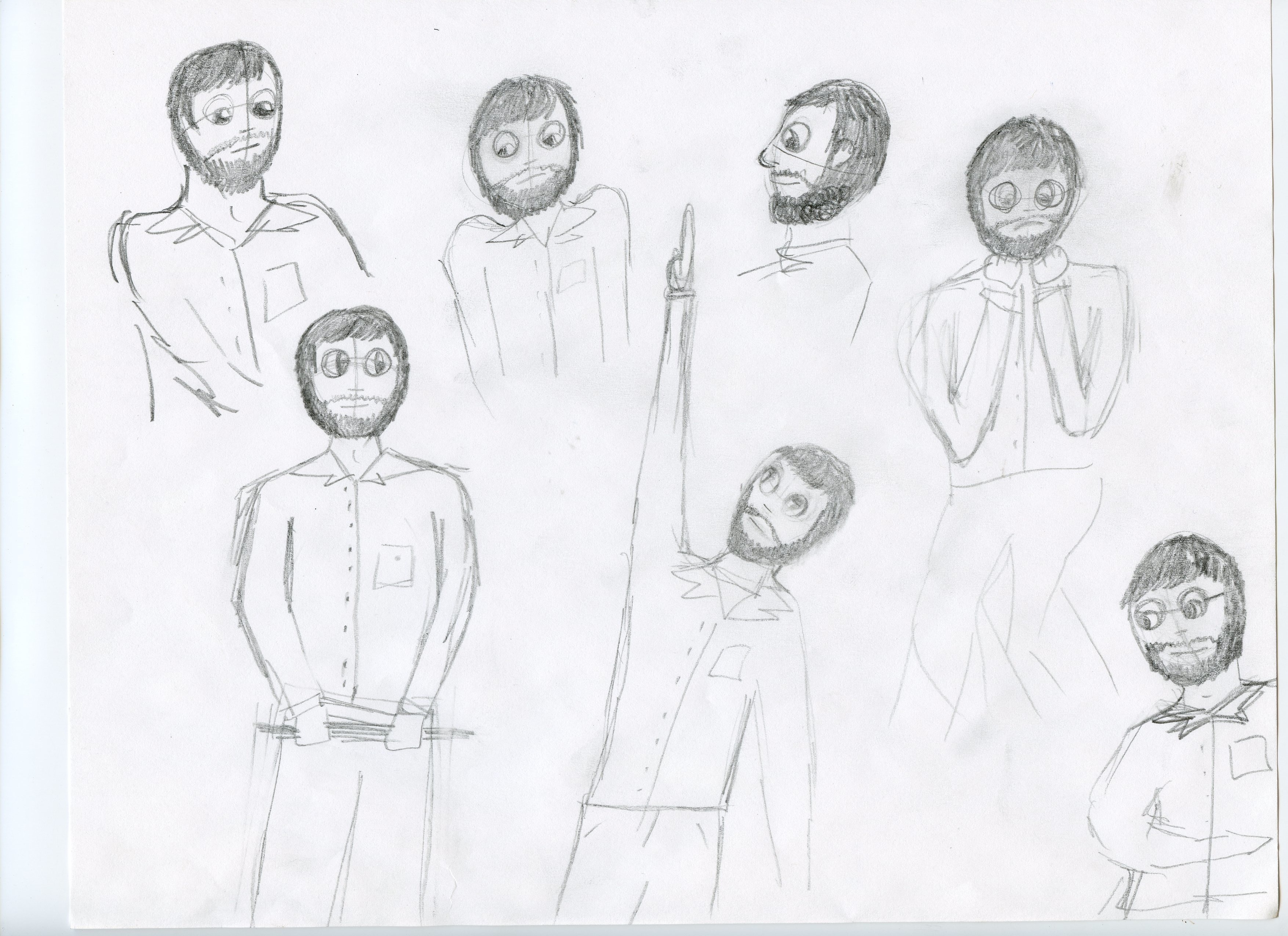
Darling Husband, in the same style. But what if I want another character with a full beard in a button-down shirt?

Darling Husband, in the same style. But what if I want another character with a full beard in a button-down shirt?

Ultimately, when I start the graphic novel, the kids will probably have to stand in as models. A certain degree of cartoonishness is acceptable to me, but only up to a point. The proportions of the bodies and the faces needs to be somewhat realistic.

Comics! Part 4

So, listen. I’m going to draw comics. Somehow. Graphic storytelling is the future. For a long time, I thought I could find artists to illustrate my stories. I’ve long had the entire script for an X-rated speculative fiction BDSM graphic novel in my head. It would be very serious, and very sexy. If you’re into that sort of thing. I don’t know if I’ll ever have the ability to draw what I can see, but I’m going to draw something.

My first web comic

My first web comic

When I got the Wacom Intuos, this is the very first thing I drew, just to assure myself that drawing a comic page was not beyond my ability. And I’ve actually gotten better at digital drawing since then. I think it makes sense to sketch things on paper first, though. It’s easier to see the big picture that way, and, as another artist pointed out (wish I could remember who for the shout out) if you don’t do hard copies, you can’t sell originals.

Comics! Part 3

I’ve probably drawn hundreds of one-panel things that are like surreal cartoons, I’ve never quite gotten the hang of telling a story in pictures. My words tend to overwhelm the pages, I can never make the characters look like the people from panel to panel. And I’ve tried.

Crack Cats in Suburbia. Unfinished, but a high-res scan. If you blow it up, it’s possible to read.

These two unfinished comics, Crack Cats in Suburbia, were drawn in 1996 or 1997. I was heavily immersed in the counterculture at the time. We didn’t watch TV or listen to the radio. The strip was about a sense of alienation in a mainstream world, but also about finding a person to be an outcast with, as Dr. Seuss said: someone with a compatible weirdness.

I wanted so badly to draw this comic but could never get it right, and the more I worked at it, the further it was from completion.

I didn’t try to draw a full-page comic strip again until 2010, when I read this funny article by Shalom Auslander. I actually really enjoy his writing, but there was something so upsetting to me about the “loathsome writing jobs” reserved for people who didn’t know enough about writing, because of course, I was working at one of those loathsome writing jobs at the time, and I was ALSO writing fiction. Which no one liked. Whenever I read published authors with actual audiences complaining about how hard writing is or how they are crippled by their own self-doubt, I want to find and punch them. Although I did find it amusing that one of his demons was whether or not Philip Roth had done it first, since he’s easily compared to Roth. Anyway, I don’t want to hear any successful artists complaining about being successful artists, especially if they have spent years doing a loathsome job in the field.

I must have tried a dozen different punchlines but they never came out right. I was searching for that balance between comedy and outrage.

I must have tried a dozen different punchlines but they never came out right. I was searching for that balance between comedy and outrage.

Comics! Part 2

Early 2010, around the time my husband and I first moved in together and I had just started the mandala project. Some of the gold plate/lettering has turned green because my gold Crayola was VERY old and some of the old Crayola metallics used actual copper to get the metallic hue. So, literally, this drawing has begun to tarnish.

Early 2010, around the time my husband and I first moved in together and I had just started the mandala project. Some of the gold plate/lettering has turned green because my gold Crayola was VERY old and some of the old Crayola metallics used actual copper to get the metallic hue. So, literally, this drawing has begun to tarnish.

My natural style, I guess, is a bit cartoony. My people never look like real people, my subject matter runs toward the fantastic, and I tend to add a lot of words. I wish that my work looked serious, but this is what I have. The artist Phil Foglio (whose work I didn’t appreciate when I first saw it in conjunction with Robert Aspirin in the 80s, but later enjoyed on Magic: The Gathering cards, and now, naturally, adore on Girl Genius) is famously quoted as saying that his art career originally stalled because publishers found his work “too cartoony” (except for cartoon publishers, who told him he wasn’t cartoony enough) after which he and his wife won so many Hugos that they had to refuse the nomination to give someone else a shot at the award.

Absent-minded sketching during the world's slowest Scrabble games. Jack and Beanstalk, Little Red Riding Hood, Rapunzel, a random chick on a dragon, and proof that I usually win at Scrabble.

Absent-minded sketching during the world’s slowest Scrabble games. Jack and Beanstalk, Little Red Riding Hood, Rapunzel, a random chick on a dragon, and proof that I usually win at Scrabble. Rapunzel is wistfully dreaming of a prince, which suggests to me that I was probably single when I drew this. I’m guessing 2007 or early 2008.

Even when I wasn’t doing a lot of art, I was always doodling in margins. This kind of work is less polished, but sometimes it seems to have more life to it than some of the stuff I worked at.

Another little piece of fantasy from the edge of a Scrabble scoring sheet.

Another little piece of fantasy from the edge of a Scrabble scoring sheet. I won that game, too.

It’s almost a nervous habit; if there’s a pen in my hand, I want to use it. I think this is actually some of what Bantock was getting at in The Trickster’s Hat. If you can draw like this, without any attachment to the outcome, but a unshakeable attachment to the process, then you can keep yourself from getting hung up on whether or not it’s good enough and just make art all the time.

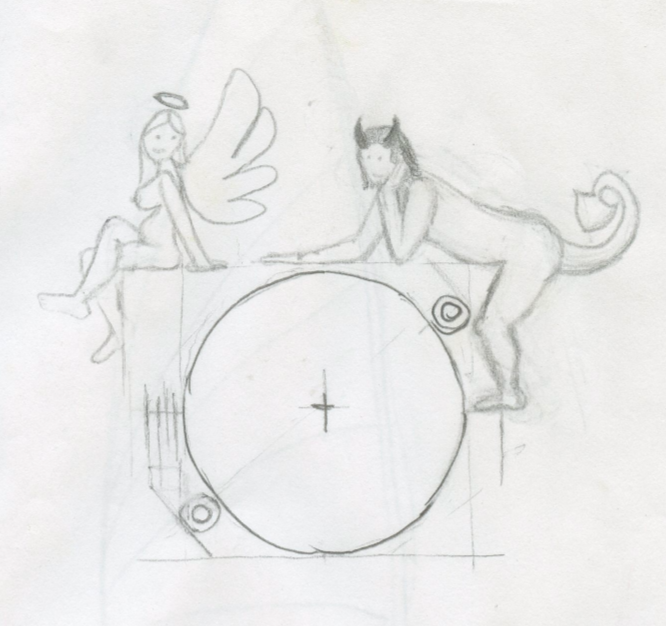
I’ve dated a lot of engineers. The mechanical bit in the center here is something that a guy I dated was working on. When he finished, I added me as an angel and him as a devil to the design. Just draw on everything is my point here.