Category Archives: comic

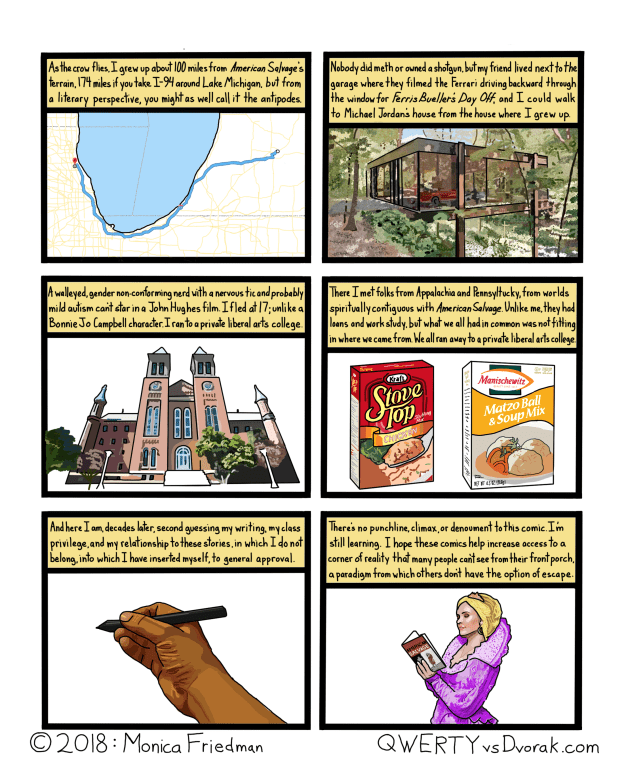
How and Where I Enter

american salvage template my class comic_edited-1

According to my insider sources, all the 1 percenters read standing up whilst wearing tiaras.

There are a lot of ways of looking at any piece of fiction. After rewriting and illustrating 30 of Bonnie Jo Campbell’s short stories and telling her story about writing American Salvage, it seemed like I could/should write my story (apology?) about making these comics. A little piece of it anyway, which was much harder to tell than I thought it would be. It took all week to finalize the text; my first draft would have filled the entire page with words and never even got past panel 4. I guess I’ll have to write another comic about growing up in the North Shore of Chicago when you’re just not like the other humanoids, because John Hughes never got too deep into that story.

I think I mentioned the details about panel 2 in a previous blog post, although I can’t seem to find it, but Ferris Bueller, Michael Jordan, &c: true story. Panel 3 depicts “Hassle Castle,” which is what we called the admin building at Antioch College. The building, we were always told, was designed by the same guy who designed the Smithsonian Castle in Washington, DC. The side I drew was originally built as the front door of the school, at which time it faced a railroad station and only had 2 buildings behind it. Later, the train line was shut down and the school expanded behind the Castle and now this is the back of the Castle, facing 1000 acres of protected wilderness (nice backyard!) and the old back of the Castle is now considered its front.

Panel 3 has a little backstory. I’m not sure I ever ate Stove Top Stuffing in my life; if I did, it certainly wasn’t at my mother’s house. We didn’t use boxed matzah ball mix either, but Antioch College is in a tiny town in southwestern Ohio, so I couldn’t necessarily be particular about ingredients while I was at school. Anyway, I was cooking it in the minuscule shared kitchenette in Birch Hall. At Antioch, I met a number of lovely and academically talented people who referred to themselves with some degree of pride as “white trash,” and one of these people came in to use the kitchen at the same time. She saw the box and asked me what the heck it was. I explained matzah balls and then added, “I’m cooking from my culture,” and she indicated her box of Stove Top Stuffing and said, “I’m cooking from my culture.” So that happened.

Even as a starving artist, I’ll always be an outsider to American Salvage, but I hope I got into it pretty well.


Metropolitan Industrial Salvage

american salvage template craigs_edited-1

That flattop is awesome and I don’t see how it could fail to make anyone smile.

It was pretty nice of Craig to write this script for the Upcoming American Salvage comic, not only because we gave him about 6 seconds notice that he was getting a page in the book, but also because last year he published an entire comic book about the history of Portage Printing (I drew 3 pages for him) and it’s sort of amazing that he still had any material left over. I thought he might have some kind of clever advertisement in his back pocket, already prepared, but he managed to come up with an original story that ties back into the “salvage” theme of the rest of the book.

I’ve never been to Portage Printing: when I lived in Kalamazoo I had a 500-page a semester copy code from the university, plus I got one of the secretaries to give me an unlimited code so I could secretly make copies of my 600-page novel in the middle of the night. However, I suspect it’s a top-notch place. Craig has really created an amazing business model, combining an obvious passion for professional excellence with the unforgettable marketing device of filling his workplace with old-timey artifacts. If you happen to be in southwestern Michigan and need to print a comic book or something like that, I highly recommend checking his place out.

Craig sent me some of the source images, and his loyal customers provided some others via the Portage Printing Yelp page.

The Origins of Super Bon Bon

american salvage origins super bon bon_edited-1.png

I continue to not understand why a plain black dress costs as much as an F-350 stake-bed truck.

Bonnie Jo had the idea for a comic about the origins of American Salvage, and she sent me about 6 sentences, one per panel, and then we sort of bounced the script back and forth until it worked for both of us, so this is actually the first true collaboration we’ve done in 2 books. The other 31 (thirty-one!) comics I’ve written about her work didn’t really involve any direct communication or feedback during the process. So this was fun. I love memoir.

The dog in panel 5 was named Rebar, and he only had 3 legs. The picture of me in panel 6 is totally recycled from the last book. The donkey in panel 4 is the only donkey I drew for American Salvage, while Mothers, Tell Your Daughters is full of them. American Salvage, on the other hand, features many more drawings of blood and weapons.

Boar Taint

american salvage 14 boar taint_edited-1

Can you tell that I’m pleased with myself? Can you tell that I’ve never seen a feral boar hog?

Jill is probably the Bonnie Jo Campbell character with whom I most strongly identify, because we’re both idealists who believe that, armed with only our advanced degrees and our own sense of self-righteousness, we can accomplish anything. Also, we both swear we’re only going to eat one square of dark chocolate a day. And then we both become overwhelmed with self-loathing when we fail.

I ended up cutting out more of “Boar Taint” than I intended, particularly the parts of the story that involve Jill’s awareness of being a woman surrounded by men, and of her concern for the Jentzen woman, who appears to be the only female in a household comprised entirely of men, who, presumably, are all inbred cannibal cultists. Speaking of which, those inbred cannibal cultists came out great. (Note: the text does not ultimately support the cannibal cultist theory, but it does give you the sense that Jill is walking into Texas Chainsaw Massacre or The Hills Have Eyes right up to the point where she drives off with the boar hog.) Also, the panel in which Jill’s husband (his name is Ernie, and the story also lets us know that he and Jill are really in love and spend every night humping like rabbits) tries to gently explain to her that nobody is selling a high quality stud pig for 25 dollars looks pretty sweet.

Anyway, that’s a wrap on American Salvage. It took twice as long as Mothers, Tell Your Daughters but the illustrations are probably twice as good. I gave myself a deadline of New Year’s Eve to finish the 14 stories in this book, because then I wouldn’t have to change the copyright date on the bottom of my template. Deadlines are helpful. Next year, I’ll create the cover and some other supplemental material, and I understand Bonnie Jo wants to bring the print comic out in time for a literary festival in March, so look for Bonnie Jo Campbell Comics v. 2 in the spring. Fingers crossed, next year I’ll get my chance at Women and Other Animals. 


Fuel for the Millennium

american salvage 13 fuel for the millennium_edited-2.png

I’m sure there are pole barns in heaven, but I don’t know about Faith Channel ministers. That might be a bit of a stretch. 

Obviously, Bonnie Jo did not write this story in order to explain how Donald Trump got elected, because American Salvage was published in 2009, but…I think this story kind of explains how Donald Trump got elected.

There’s not a lot of story in the story—it’s almost more of a character sketch, and it tells you, very concisely, about the kind of person who believes whatever the minister on the Faith Channel says and acts accordingly. Hal Little is not a bad guy; he’s a pretty decent guy who likes babies and birdsong and whose prejudices aren’t his own, but things he’s picked up from the people he trusts. His father taught him to have faith in his religious leaders, and so he does. So much faith that he’s destroyed his life.

“Fuel for the Millennium” is like the flip side of “World of Gas.” Hal is one of the guys driving Susan crazy with his crazy intention to control the uncontrollable. And then, what happened to these dudes after midnight on New Year’s Eve? Some of them ended up like Tiny in “Blood Work, 1999″ and I guess the rest of them became doomsday preppers. What else could they do? Nobody’s going to pay them enough money for their pole barns and windmills that they can buy back their houses in town. Plus it would be embarrassing to admit that they were wrong, so they just doubled down and kept predicting crisis at a later dater, and then they voted the crisis into office because the ministers on the Faith Channel told them to.

I chose the classic image of Jimmy Stewart calming the citizens of Bedford Falls at the start of the Great Depression because it’s the most recognizable depiction of a bank run, but also because the idea of a bank runs seems ridiculous in the 21st century. Let me put it this way: if civilization collapses, do you really think your little green pieces of paper are going to have value? Almost everybody’s money is all electronic now, and we know that it’s only our collective belief in the reality of that money that makes it real. If the sort of thing that Hal describes in this story actually happened, the chickens would be the most valuable thing you could have.

I’m pretty pleased with that chicken, as well as the drawing of the raptured pole barn.

Storm Warning

american salvage 12 storm warning_edited-1

Do you think there’s enough blood in panel 2? I’m not sure there’s enough blood in panel 2.

This is the heartwarming tale of how toxic masculinity is purified in the crucible of life-threatening injury, and, combined with fear in the alembic of loneliness, transmuted into the burgeoning crystals of the ability to express actual love. What’s hilarious here is that Doug, upon realizing that he loves Julie, immediately tries to convince himself that he doesn’t really care for her, because, I guess, it’s not manly to have feelings? And then, as it happens, once he’s wholly dependent on her, he doesn’t want to acknowledge that he even likes or respects her. Only when he’s got less than nothing does he finally admits to himself that Julie is kind of a peach if for no other reason than she puts up with his ridiculousness.

I wonder how the story would have gone if Julie had been the one injured and Doug had to choose between nursing her through her convalescence or running away.

This comic was a lot of fun to draw. It took 10 days because my power cable broke and then I got the flu, and some of the images were pretty challenging, but I love the results. Probably the wounds would be worse in panel 2, but then it would have just been a cloud of blood, and that’s less interesting to look at. In panel 6, I realize that Julie is likely supposed to be wearing a jean jacket with no shirt underneath, but let’s say that she went home and changed before she came back. Probably, she left the bar still mad at Doug, then went home, then realized that she left a basically paralyzed guy alone in a lake house during the storm of the century and started to feel bad as she sobered up and then went back to babysit his crabby self. That’s love.

This is one of the happiest stories in the book, I feel.

I was telling my friend the coyote about how I had to draw a picture of a girl coming into a dark house during a power outage and he said, “That sounds hard,” and I said, “Not as hard as getting up early and wearing a tie 5 days a week for 30 years,” and I meant it. Hallelujah, making webcomics is the best job I’ve ever had.

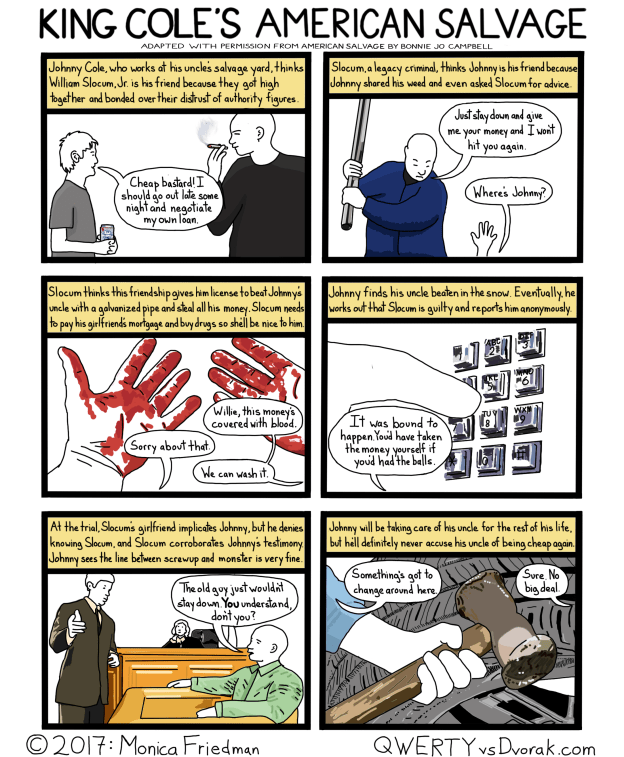
King Cole’s American Salvage

american salvage 11 king coles american salvage_edited-1

I didn’t notice the parallel between Slocum holding the galvanized pipe and Johnny holding the sledgehammer until after I drew it. Panel 6 should have been Johnny standing in the same attitude as Slocum in panel 2. In case you haven’t read the book, Johnny is not threatening his uncle with the sledgehammer; he’s just knocking the tire off an old Lincoln Town Car.

A really difficult comic for me, almost on the level of difficulty of “To You, as a Woman.” It’s just so sad. It didn’t help that, the day before I started working on it, The Man asked me to watch The Green Mile, which I had never seen (or read—I was an avid Stephen King fan as a young person, and the publication of the book coincided with the end of my love affair with his work) and it really crystallized the feeling of being overwhelmed by pain and suffering and man’s inhumanity to man. There’s not a lot of hope here: Slocum is clearly irredeemable, and Johnny’s path to responsibility is guilt-ridden and regrettable. Also, many people know that I spent 5 years taking care of a friend with a traumatic brain injury, so that pain is all too familiar. Plus, trying to draw the same character in a variety of poses always stresses me out.

Nevertheless, she persisted.

It took an entire week to create this comic, working in bits and pieces because the whole was too terrifying to contemplate, but I powered through and finished around 3 a.m. Sunday night. Then I uploaded it. I uploaded it 6 times. Every time I uploaded it, I saw a mistake and felt compelled to go back and fix it. The first 5 were kind of little: 2 of them were missing apostrophes, and 1 was that Slocum didn’t have an ear in panel 5. But the 6th time, the time I said, “OK, now it’s got to be right,” I noticed a mistake in the title. Among my writer friends, I’m considered a pretty excellent copyeditor, but somehow I had gotten through the entire process (I drew the title first) without noticing that “American” was misspelled. That’s when I gave up and went to sleep because it was almost 4 a.m. and if I’d overlooked that, who knows what I might have overlooked, and how would it be possible to discover it in any case?

The next story in the book is a lot more pleasant, although it also involves gross bodily injury of the sort that will likely affect the character for the rest of his life, but at least it doesn’t feature any psychopaths.


Falling

american salvage 10 Falling_edited-1

The redemptive power of produce.

I am completely satisfied with this comic. The fruits, the vegetables, the script, the visual juxtapositions, and the layers of symbols. The story is more hopeful than some of Bonnie Jo’s work; that’s why I used the mason jars in the last panel, even though they were destroyed by a fire. For that narrator, they were an aspect of home, and even though her house burned down, she’s still creating this sense of family out of these men, so that a camper, a garage, a tent, and a garden become a home.

Bringing Belle Home

american salvage 9 bringing belle home_edited-2

So, yeah, I imagine Belle looks a lot like Kristen Chenoweth.

This one was hard! There aren’t a lot of visual symbols to work with besides Thomssen’s perception of Belle as a physical being, and cutting down to the bones of the story required a brutal touch. There’s love and there’s domestic violence and there’s terrible childhood memories and there’s self-medication. It’s about a guy who tries so hard to love but he can’t seem to get it right. She tries to tell him that she’ll never really let him love her, but she’ll keep taking from him. He can’t hear it anyway. They’re both so out of touch. They’re both broken beyond repair.

I spent way too long drawing those liquor bottles in panel 2. The Cuervo isn’t mentioned in the story but the other brands are, and I needed one more bottle to fill the panel properly. The juxtaposition of the “We can change” quote in panel 4 and the implication in the story about Belle keeping the change and never tipping the bartender was unintentional, but now it pleases me. The image in the last panel could have also been Belle sitting in Thomssen’s living room with a broken window behind her and the snow blowing in. She’ll still be wearing canvas shoes with no socks and Thomssen’s sweater with no coat because she doesn’t know how to protect herself from the cold.

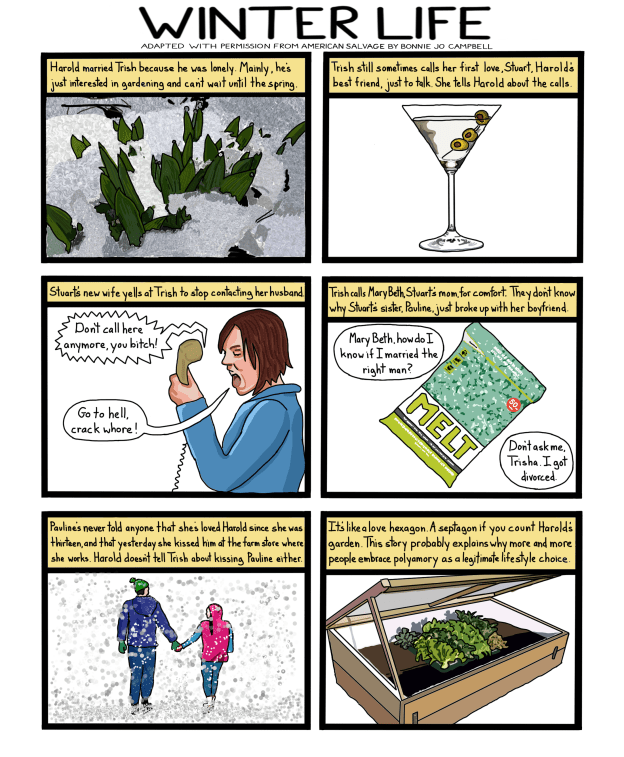
Winter Life

american salvage 8 winter life_edited-1

If you count Stuart and Pauline’s mom, Mary Beth, who likes everyone, it’s a love octagon.

Loneliness, or fear of loneliness, is probably the number one reason people make regrettable choices when it comes to marriage. People like Mary Beth figure that out, and accept the loneliness rather than make the same mistake twice. People like Harold double down on their mistakes, try not to think about it, and commit ever more intently to a course of action. Harold knows that he will never leave Trisha, even though she’s a sloppy drunk who’s in love with his best friend, even though there’s a girl who loves him more and is probably better for him waiting at the farm store. He’s made his choice and he won’t hurt Trisha. And then there are the Trishas of the world, marrying in haste, repenting at leisure, and not really having any degree of self-reflection about it.

And Pauline, of course, will probably always be lonely. Why didn’t she say something to Harold before he married Trisha? Fear of rejection, right?

For a while I had trouble pulling visual symbols out of the story; I didn’t want to draw Harold and Pauline kissing in the farm store. The best image is the memory of Harold and Pauline walking home in the blizzard, holding hands and still wearing their skates. Lucky me, I didn’t read the passage correctly the first time and spent quite a while drawing their skates slung over their shoulders. But they wore their skates back to Pauline’s house, where Harold has been living because his dad is not OK, and took them off in the mudroom. Ultimately, the story is called “Winter Life” and all Harold is thinking about is the spring, even though for Pauline the most important moment was the winter. But Harold loves his garden the most, he can’t wait for growing season to begin, and this year he’s going to get a jump on it with cold frames. He’s shopping for ice melt. What happens in winter stays in winter.