Mapping Stories

Jacks, my little hero

Jacks, my little hero. From the unpublished novel The Girl Who Followed Her Own Counsel. Drawn sometime in the late 90s. 

It took me 17 years to write the first draft of my first novel, and while the storytelling came hard, the characterization and world-building came easy. I lived in that world for years, and it’s an easy one to go back to. I believe I did sketch out at the major city at least once, but it was a picture drawn from memory; I didn’t need or use it as a reference, because I knew exactly where everything was. I knew it so well that when I wrote the sequel, I still didn’t need the map, even though the characters spent time the other side of town, where Jacks rarely ventured in the first book. I wish I still had that map, but I have a feeling it’s long-gone; I haven’t seen it in years. Possibly, it was done in a notebook, in which case it might turn up.

Mallory's mansion, from my 9th unpublished novel, The Hermit, sketched on the back of a library receipt.

Mallory’s mansion, from my 9th unpublished novel, The Hermit, sketched on the back of a library receipt.

Mallory’s mansion was the first time I needed to sketch out a scene I couldn’t hold in my head. It’s a sprawling, one-story adobe, built around a series of inner courtyard gardens, and this drawing helped me keep the protagonists’ progress through the building straight in my mind. Kaija, the eponymous hermit of the novel, knows the building well, but she hasn’t been there in years. Mallory has passed away, and Kaija and her friend, Little Brother, are systematically searching the rooms for a message they believe Mallory may have left.
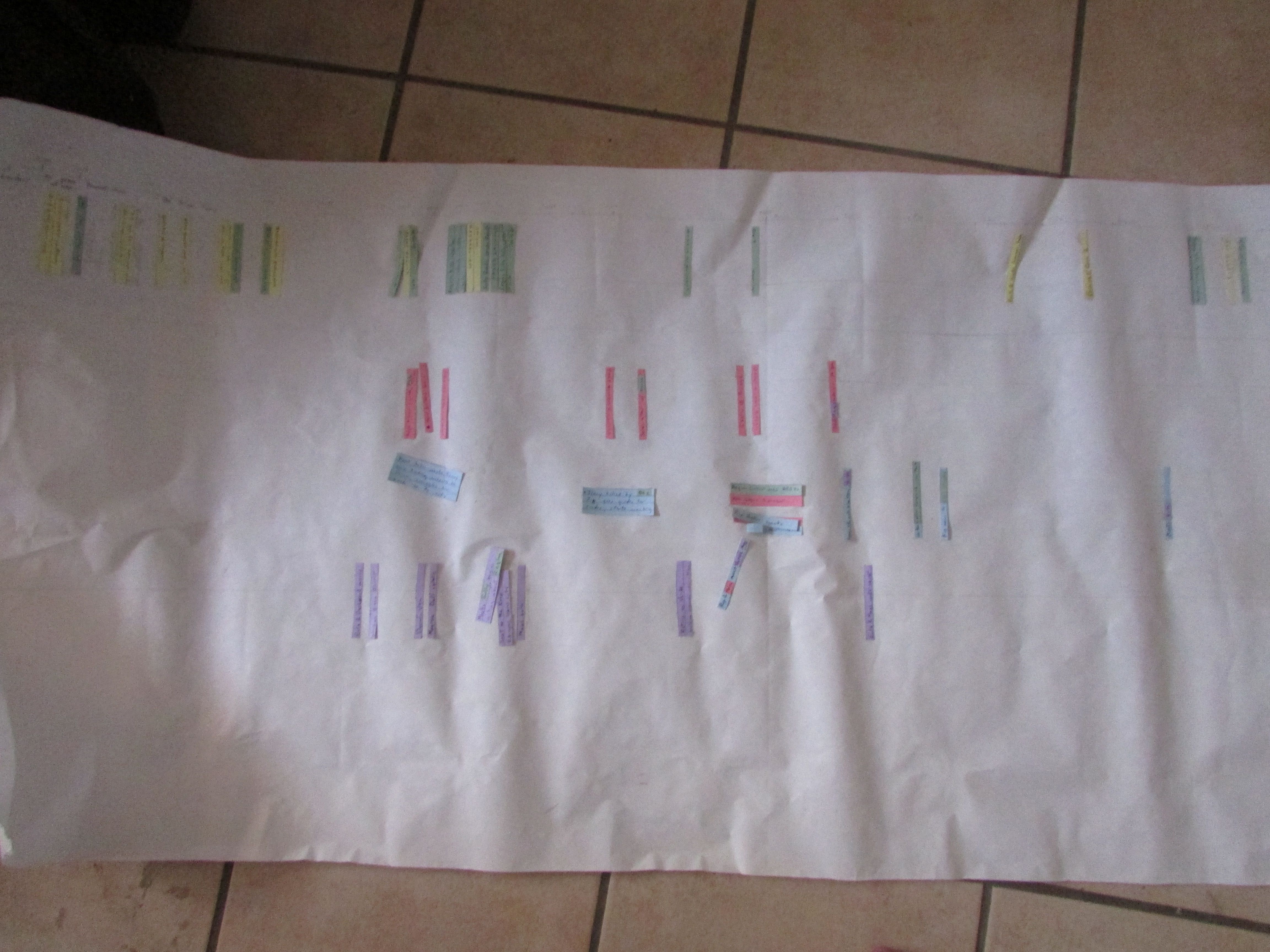
New Pueblo timeline, showing the history of the city and the history of several families, along with the protagonist's progress.

New Pueblo timeline, showing the history of the city and the history of several families, along with the protagonist’s progress, from my 10th unpublished novel, Greenpunk

When I started Greenpunk, I knew it would be at least as complicated as The Girl Who Followed Her Own Counsel, and also that it wouldn’t be a world I could live in. First of all, it’s a dystopian novel and not as pretty as Jacks’s world, and second, my aging brain can’t handle spending 17 years on a first draft. The 2 years it actually took really wore me out; I still haven’t started revising, because it was so cumbersome to gestate (800 pages!). To keep the details straight, I used 2 visual mnemonic devices: a timeline, and a family tree. The timeline actually starts a hundred years before the novel; it’s a murder mystery, so the backstory needed to be firmly in place before the writing began. I started the timeline before I started the novel, added to it as I became more familiar with the world, and then set it aside about 2/5 of the way through the story, once all the characters had met. At that point, I mostly only consulted it to remember the ancient history, the things that happened before the main characters were born.

The Collier family tree. On the off chance that I ever finish revising and sell this novel, I’ve blotted out the details that are mysteries in the book so as not to accidentally ruin the surprise. If it ever comes to that. I don’t think it’s possible to actually read the timeline above, so I didn’t bother editing that, although it’s full of spoilers.

The Collier family tree was a document I consulted frequently as I wrote. Not only did it help to keep the history of the city’s most illustrious family straight as Rip, my protagonist, began to sort it out himself, it also gave me easy access when I needed to bring in new characters. Looking at this chart, which I drew before I started writing, allowed me to answer questions such as, “Who are so-and-so’s confidantes?” and “Which characters are most likely to rebel against the patriarch?” and “Who dislikes whom?”

Darkest Agola, a child's fantasy world, set on top of his physical world

Darkest Agola, a child’s fantasy world, set on top of his physical world

I’m excited, because the night before last I drew the above map. The first week of August, I’ll be taking a writing retreat to Flagstaff with another writer, where I hope to draft the entire script for the graphic novel I want to start drawing in the fall. This map helps me envision a lot of the story. My protagonist, Prince, is 10 years old on page 1. He lives on his family’s farm, but he envisions it as a magical world where he can set the rules. The upper right hand corner represents the part of the farm his grandmother sold off before he was born, which is now a suburban cul-de-sac. Obviously, a lot of the story’s conflict takes place at the border between these 2 worlds.

A lot of the writing is done in my head, often long before words get committed to paper. Maps, timelines, and family trees help cement the details so they’re firmly drafted before the actual draft.

 

Soft Craft

The only thing I can really competently sew is a curtain. I’m envious of those people who whip out renaissance dresses and elf coats and doll clothes and leather bags. It seems impossible to me. When I try to make a quilt, I start out with the best intentions and perfect squares but soon enough my lines are diagonal and nothing lies flat.

The Monica Doll, slightly worse for the wear

The Monica Doll, slightly worse for the wear. I still have the human-sized overalls my mother made for me from that purple denim.

This is a ragdoll I made for a guy I dated in college, so he could take me with him on a semester abroad in Japan. He gave me a hand made bracelet of copper mail. Both the doll and the bracelet were imperfect creations and kept breaking (links falling off the jewelry, seams bursting on the doll), and we had to keep asking each other to fix them. When we broke up, almost 20 years ago, he kept the doll and I kept the bracelet. They were both broken, like our relationship, and neither one of us wanted to invest the energy to fix the tokens when there was nothing left to fix them for.

About a year ago the guy contacted me on Facebook and asked if I wanted the doll back. I was frankly amazed that he’d had it all this time. I had assumed he’d set it on fire, like he probably did with all the photo negatives I tried to get back from him, or, at the very least, voodooed me up. But the doll was in about the same condition. Rather then fixing the seams, which would just burst again, I lay in some good patches on her so she’s a bit sturdier than she was before, if not somewhat worse for wear, just like me.

A yarn dolly

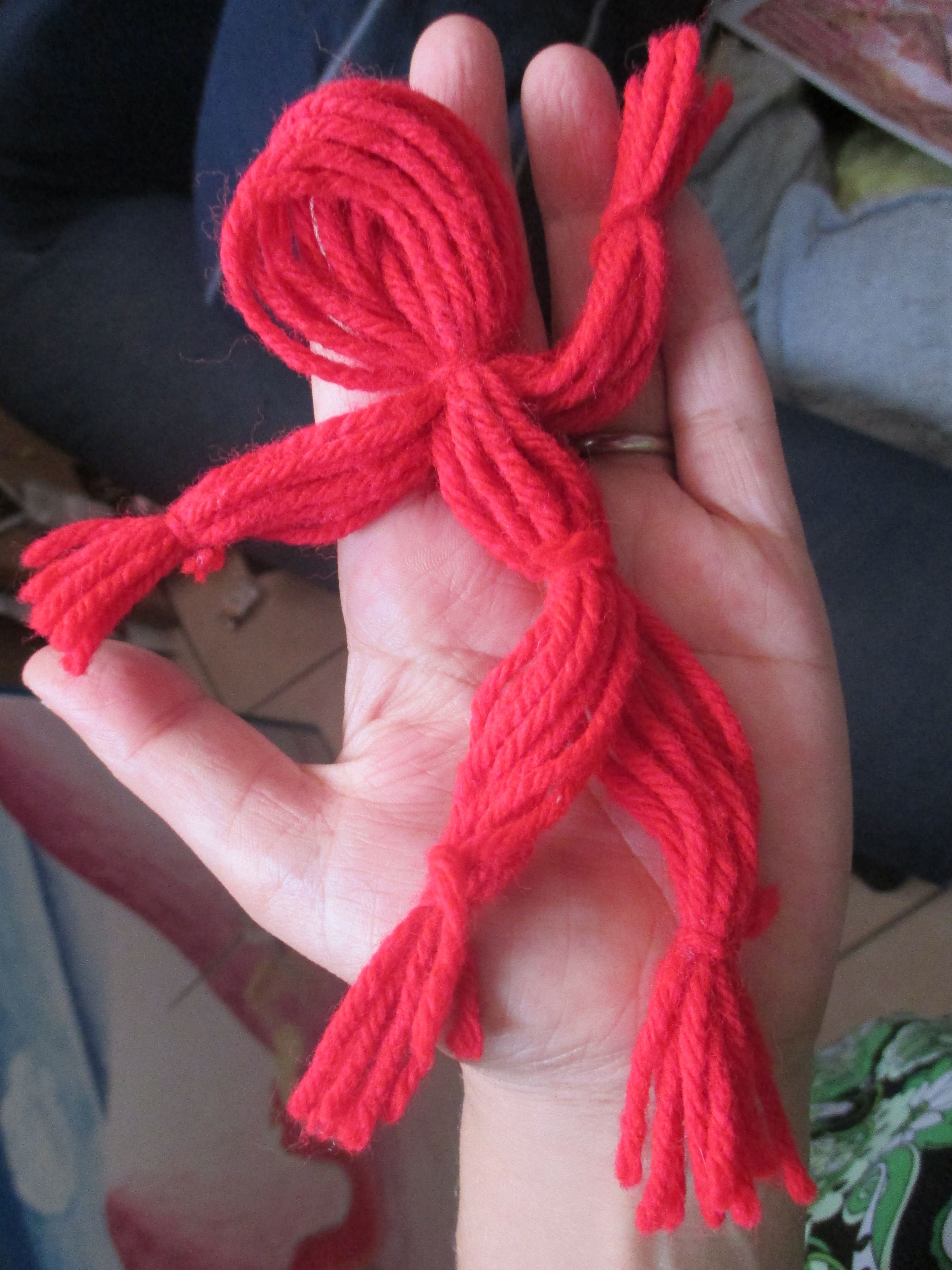
A yarn dolly

This is a simple project I did with my stepdaughter, who insists she’s really good at sewing, but really isn’t. You just wrap some yarn around your hand or a card so you have some big loops. Using a small piece of yarn, tie off the head. Then cut and tie off the arms. Tie off the waist. Separate, cut, and tie off the legs. You can dress your dolly or give her hair, but I couldn’t find anything that looked better than naked for her.

There’s Always Room for Dragons

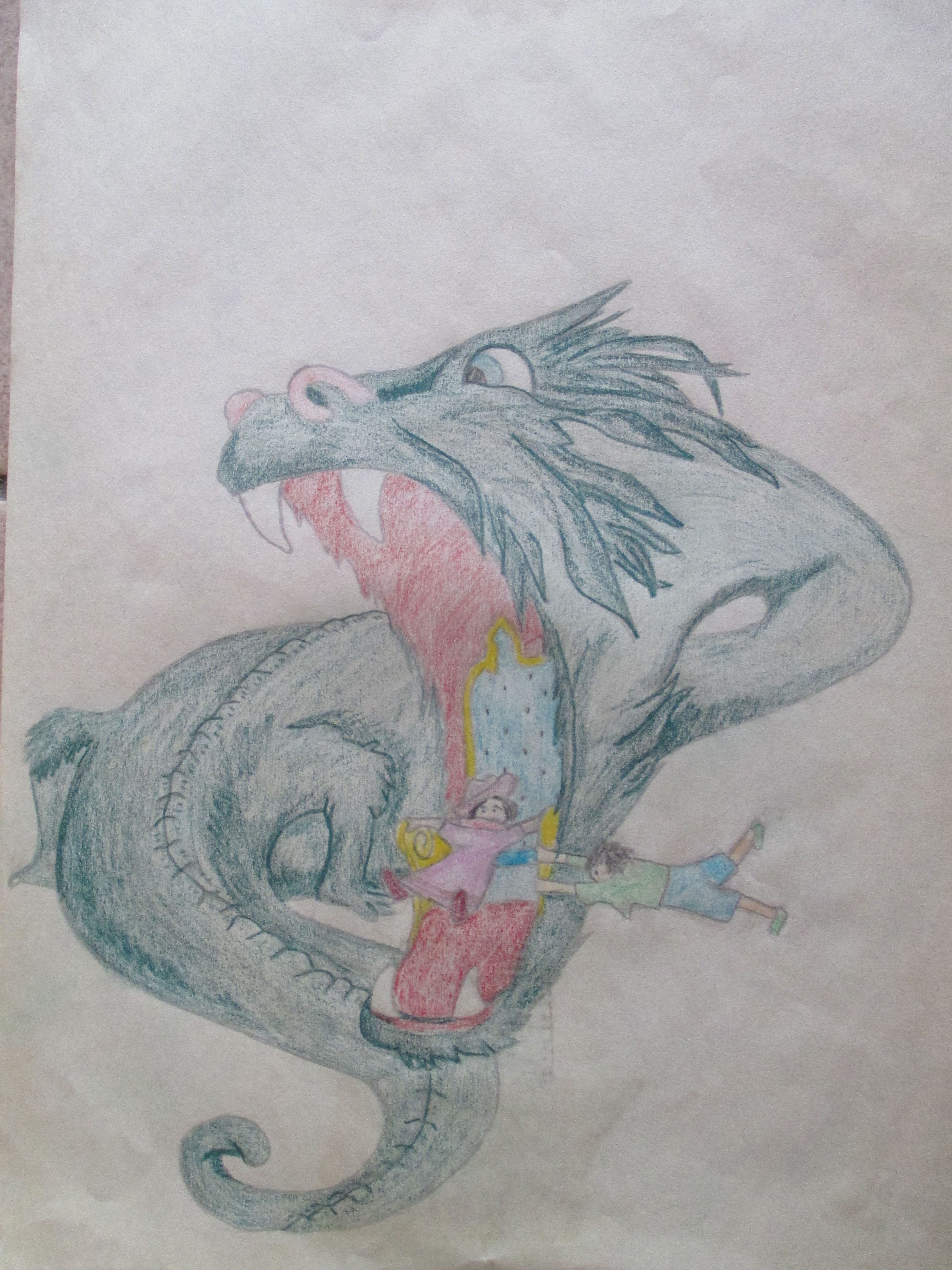
A wyrm type dragon, very chthonic.

A wyrm type dragon, very chthonic.

These are the other 2 dragons from the set of 4 mentioned in the previous dragon post. While I did enjoy playing with light on the mountains, water, and clouds in the red wyrm image, not to mention the sweet reflections on the knight’s shield, I never liked this image very much. Possibly, I was just unhappy with my color choices. I felt that they couldn’t all be blue and green (by this point I think I had acquired a full set of high quality colored pencils, and wanted them to wear down more evenly) but red and purple, at the time, were very daring choices for me.

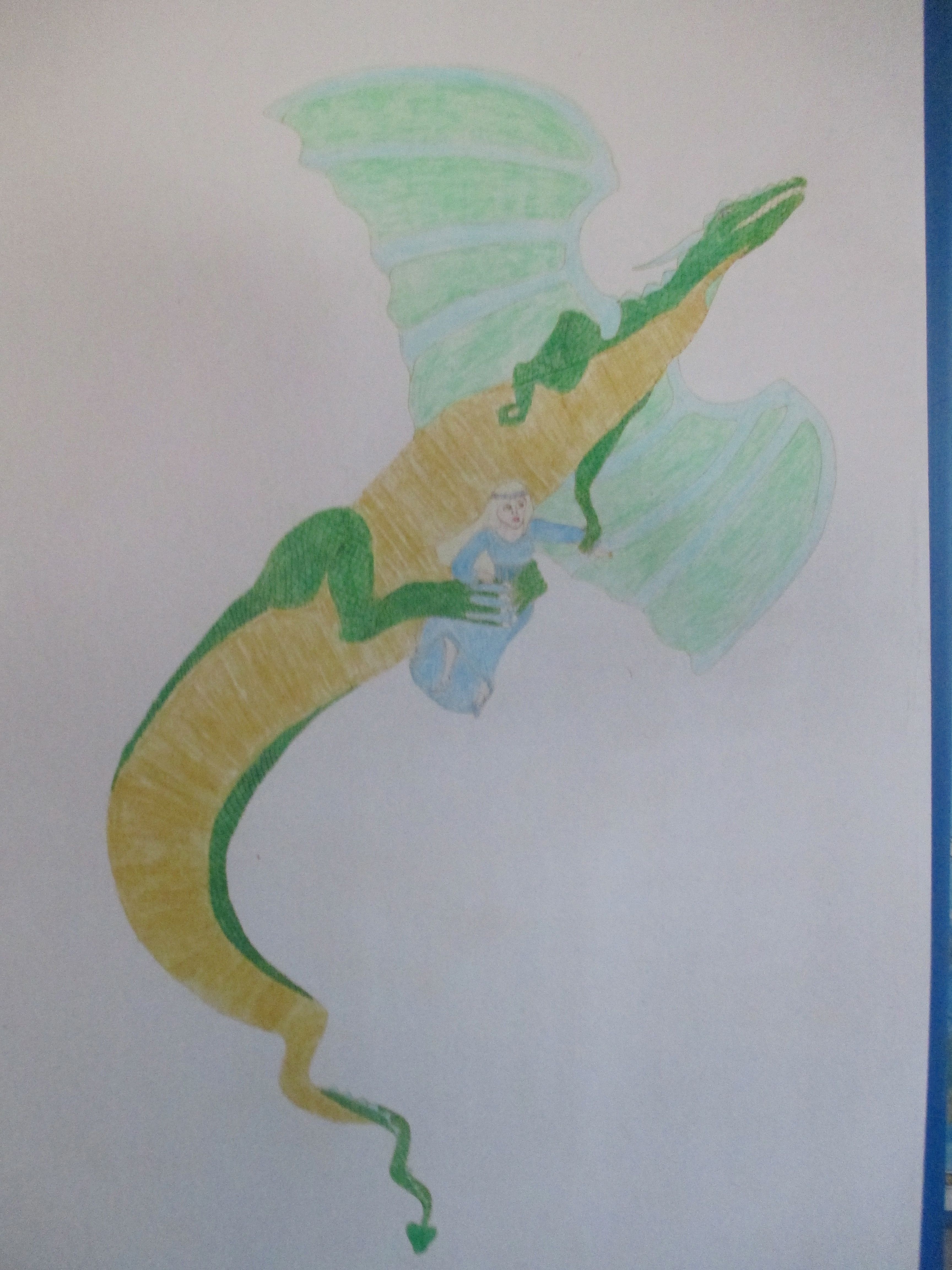
Another western dragon

Another western dragon

Here, the princess never satisfied me. She seem cartoony, and I wanted her to look, at the very least, comic booky. The dragon is pretty solid, though. Love that twist at the bottom of his tail. The colors in these images has faded over the years, revealing some of the textural imperfections.

Ereshkigal, Mesopotamian Goddess of the Underworld

Just finished and uploaded a new design to the shop, and I’m pretty satisfied. Ereshkigal is a section out of the Scroll of Wisdom, the second goddess, after Athena, in the Alphabet of Desire.

Ereshkigal, Mesopotamian Goddess of the Underworld

Ereshkigal, Mesopotamian Goddess of the Underworld

She’s a little bit creepy, but she’s an embodiment of death, so, what’s she supposed to do?

This drawing gave me a lot of trouble, both the original and the digital version. I sort of felt like she was watching me with her hypnotic eyes, as if to say, “Soon enough, you’ll come to me.”

I first met Ereshkigal in Alan Moore’s Promethea, where he retells the story of Ereshkigal having her younger sister, Ishtar/Inanna brought low. The goddess of the heavens is forced to give up all her clothes in order to descend into the land of the dead, in much the same way, I imagine, as a seeker of knowledge must shed certain thoughts and ideas that have adorned her in the past in order to unfold new mysteries.


Comics! Part 4

So, listen. I’m going to draw comics. Somehow. Graphic storytelling is the future. For a long time, I thought I could find artists to illustrate my stories. I’ve long had the entire script for an X-rated speculative fiction BDSM graphic novel in my head. It would be very serious, and very sexy. If you’re into that sort of thing. I don’t know if I’ll ever have the ability to draw what I can see, but I’m going to draw something.

My first web comic

My first web comic

When I got the Wacom Intuos, this is the very first thing I drew, just to assure myself that drawing a comic page was not beyond my ability. And I’ve actually gotten better at digital drawing since then. I think it makes sense to sketch things on paper first, though. It’s easier to see the big picture that way, and, as another artist pointed out (wish I could remember who for the shout out) if you don’t do hard copies, you can’t sell originals.

Comics! Part 3

I’ve probably drawn hundreds of one-panel things that are like surreal cartoons, I’ve never quite gotten the hang of telling a story in pictures. My words tend to overwhelm the pages, I can never make the characters look like the people from panel to panel. And I’ve tried.

Crack Cats in Suburbia. Unfinished, but a high-res scan. If you blow it up, it’s possible to read.

These two unfinished comics, Crack Cats in Suburbia, were drawn in 1996 or 1997. I was heavily immersed in the counterculture at the time. We didn’t watch TV or listen to the radio. The strip was about a sense of alienation in a mainstream world, but also about finding a person to be an outcast with, as Dr. Seuss said: someone with a compatible weirdness.

I wanted so badly to draw this comic but could never get it right, and the more I worked at it, the further it was from completion.

I didn’t try to draw a full-page comic strip again until 2010, when I read this funny article by Shalom Auslander. I actually really enjoy his writing, but there was something so upsetting to me about the “loathsome writing jobs” reserved for people who didn’t know enough about writing, because of course, I was working at one of those loathsome writing jobs at the time, and I was ALSO writing fiction. Which no one liked. Whenever I read published authors with actual audiences complaining about how hard writing is or how they are crippled by their own self-doubt, I want to find and punch them. Although I did find it amusing that one of his demons was whether or not Philip Roth had done it first, since he’s easily compared to Roth. Anyway, I don’t want to hear any successful artists complaining about being successful artists, especially if they have spent years doing a loathsome job in the field.

I must have tried a dozen different punchlines but they never came out right. I was searching for that balance between comedy and outrage.

I must have tried a dozen different punchlines but they never came out right. I was searching for that balance between comedy and outrage.

Comics! Part 2

Early 2010, around the time my husband and I first moved in together and I had just started the mandala project. Some of the gold plate/lettering has turned green because my gold Crayola was VERY old and some of the old Crayola metallics used actual copper to get the metallic hue. So, literally, this drawing has begun to tarnish.

Early 2010, around the time my husband and I first moved in together and I had just started the mandala project. Some of the gold plate/lettering has turned green because my gold Crayola was VERY old and some of the old Crayola metallics used actual copper to get the metallic hue. So, literally, this drawing has begun to tarnish.

My natural style, I guess, is a bit cartoony. My people never look like real people, my subject matter runs toward the fantastic, and I tend to add a lot of words. I wish that my work looked serious, but this is what I have. The artist Phil Foglio (whose work I didn’t appreciate when I first saw it in conjunction with Robert Aspirin in the 80s, but later enjoyed on Magic: The Gathering cards, and now, naturally, adore on Girl Genius) is famously quoted as saying that his art career originally stalled because publishers found his work “too cartoony” (except for cartoon publishers, who told him he wasn’t cartoony enough) after which he and his wife won so many Hugos that they had to refuse the nomination to give someone else a shot at the award.

Absent-minded sketching during the world's slowest Scrabble games. Jack and Beanstalk, Little Red Riding Hood, Rapunzel, a random chick on a dragon, and proof that I usually win at Scrabble.

Absent-minded sketching during the world’s slowest Scrabble games. Jack and Beanstalk, Little Red Riding Hood, Rapunzel, a random chick on a dragon, and proof that I usually win at Scrabble. Rapunzel is wistfully dreaming of a prince, which suggests to me that I was probably single when I drew this. I’m guessing 2007 or early 2008.

Even when I wasn’t doing a lot of art, I was always doodling in margins. This kind of work is less polished, but sometimes it seems to have more life to it than some of the stuff I worked at.

Another little piece of fantasy from the edge of a Scrabble scoring sheet.

Another little piece of fantasy from the edge of a Scrabble scoring sheet. I won that game, too.

It’s almost a nervous habit; if there’s a pen in my hand, I want to use it. I think this is actually some of what Bantock was getting at in The Trickster’s Hat. If you can draw like this, without any attachment to the outcome, but a unshakeable attachment to the process, then you can keep yourself from getting hung up on whether or not it’s good enough and just make art all the time.

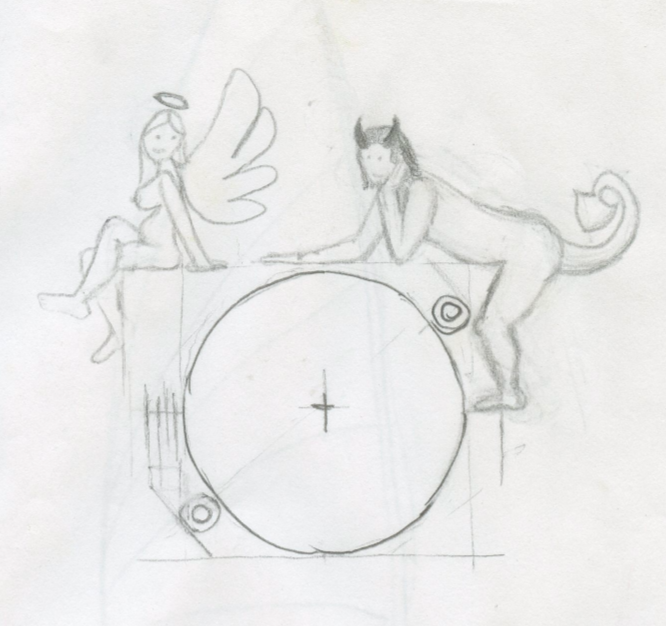
I’ve dated a lot of engineers. The mechanical bit in the center here is something that a guy I dated was working on. When he finished, I added me as an angel and him as a devil to the design. Just draw on everything is my point here.

Comics! Part 1

Characters from Bloom County: I never did a lot of copying of other people's work, but there are ways in which is can be useful/interesting.

Characters from Bloom County: I never did a lot of copying of other people’s work, but there are ways in which it can be useful/interesting.

Secretly, I’m really into comics, and always have been. Publicly, you’ll only see me with books of course. I didn’t have a lot of exposure to comics as a kid; there was no one to share them with me. Of course, I was lucky enough to grow up in the time period when Bill Watterson, Gary Larson, and Berke Breathed were writing dailies, and I still own many of their collections, but I never had access to comic books when I was little. I remember owning maybe one issue of Superman that a babysitter gave me.

Detail from Little Nemo by Winsor McKay. My theory is that everybody is influenced by Winsor McKay, whether they know it or not. So much of what we know of fantastic art originated in his pages. This drawing is from the early 90s, when I was in college. 

In high school and college I developed an interest in the history of comics: Robert Outcault and the Yellow Kid, the Katzenjammer Kids, Krazy Kat, and all that. I read everything the library had to offer me, and I did end up reading some classic comic books. A volume of the first Wonder Woman comics stands out in my mind.

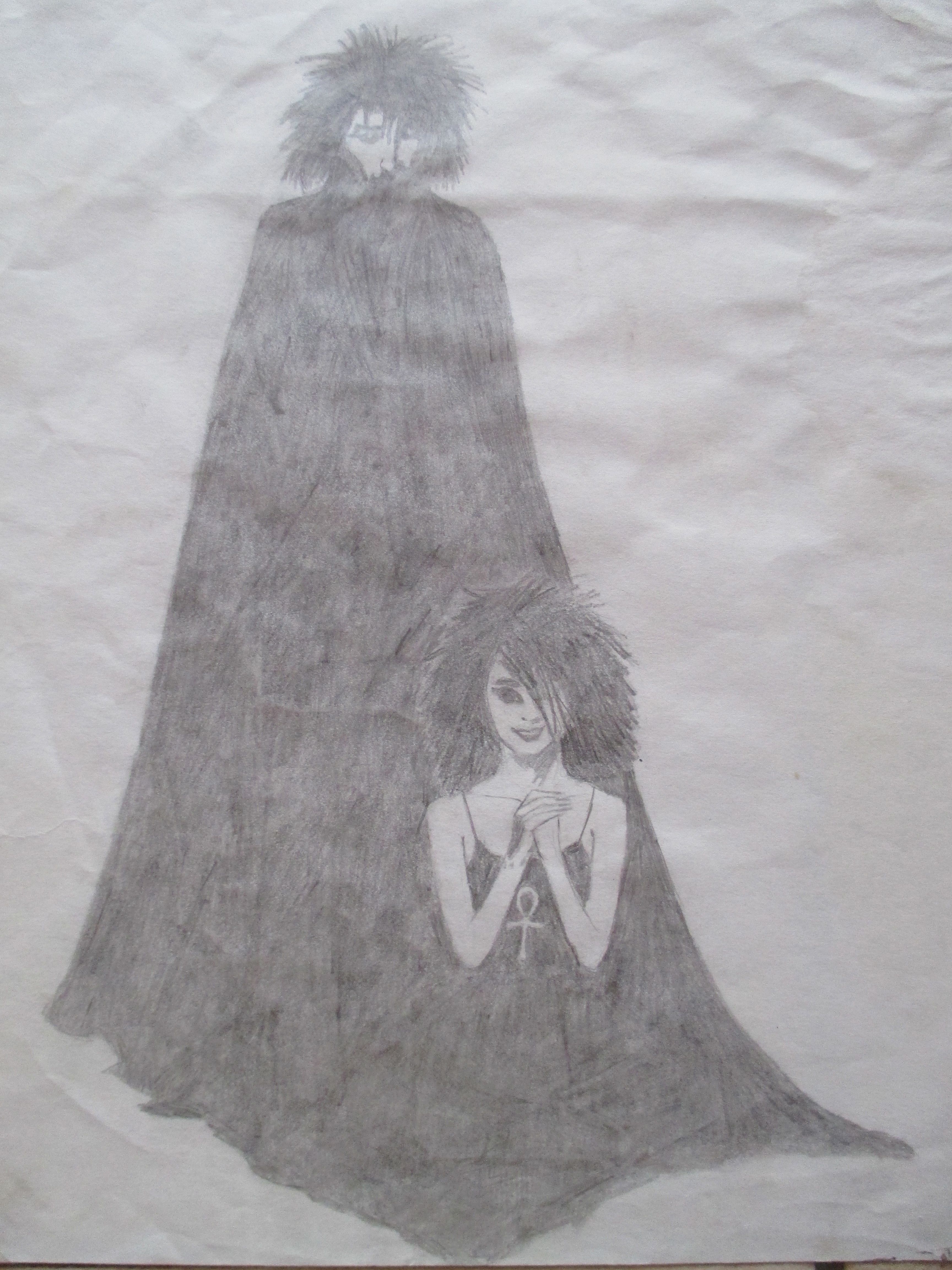
Another college-era sketch. I had done a stunning poster for a guy I liked: it featured 3 views of Death looking adorable. I put it in a poster tube to keep it safe and my mother threw it in the trash because obviously if I put a poster tube on the mantle it must because I wanted her to destroy it, and there certainly wouldn't be any point in opening it up to see if there was maybe a poster inside it. I never could recreate that work. I gave the guy a less awesome picture of Death I drew, and later we dated for almost a year.

Another college-era sketch. I had done a stunning poster for a guy I liked: it featured 3 views of Death looking adorable. I put it in a poster tube to keep it safe and my mother threw it in the trash because obviously if I put a poster tube on the mantle it must because I want her to destroy it; it’s not like I was capable of throwing out my own trash, and there certainly wouldn’t be any point in opening it up to see if there was maybe a poster inside it. I never could recreate that work. I gave the guy a less awesome picture of Death I drew, and later we dated for almost a year.

Sandman was probably the first graphic novel I ever read, and of course the storytelling and the artwork are both stunning. After that, I read every graphic novel anyone gave me, a rather eclectic assortment. It wasn’t until grad school that a guy introduced me to Alan Moore. I read The Watchmen first. Talk about amazingly good storytelling! I’ve read a fair amount of his work. My favorite is definitely Promethea, which might not be as objectively good as his other stuff, but which I adore. It’s the catalyst for my Alphabet of Desire.

Kitties!

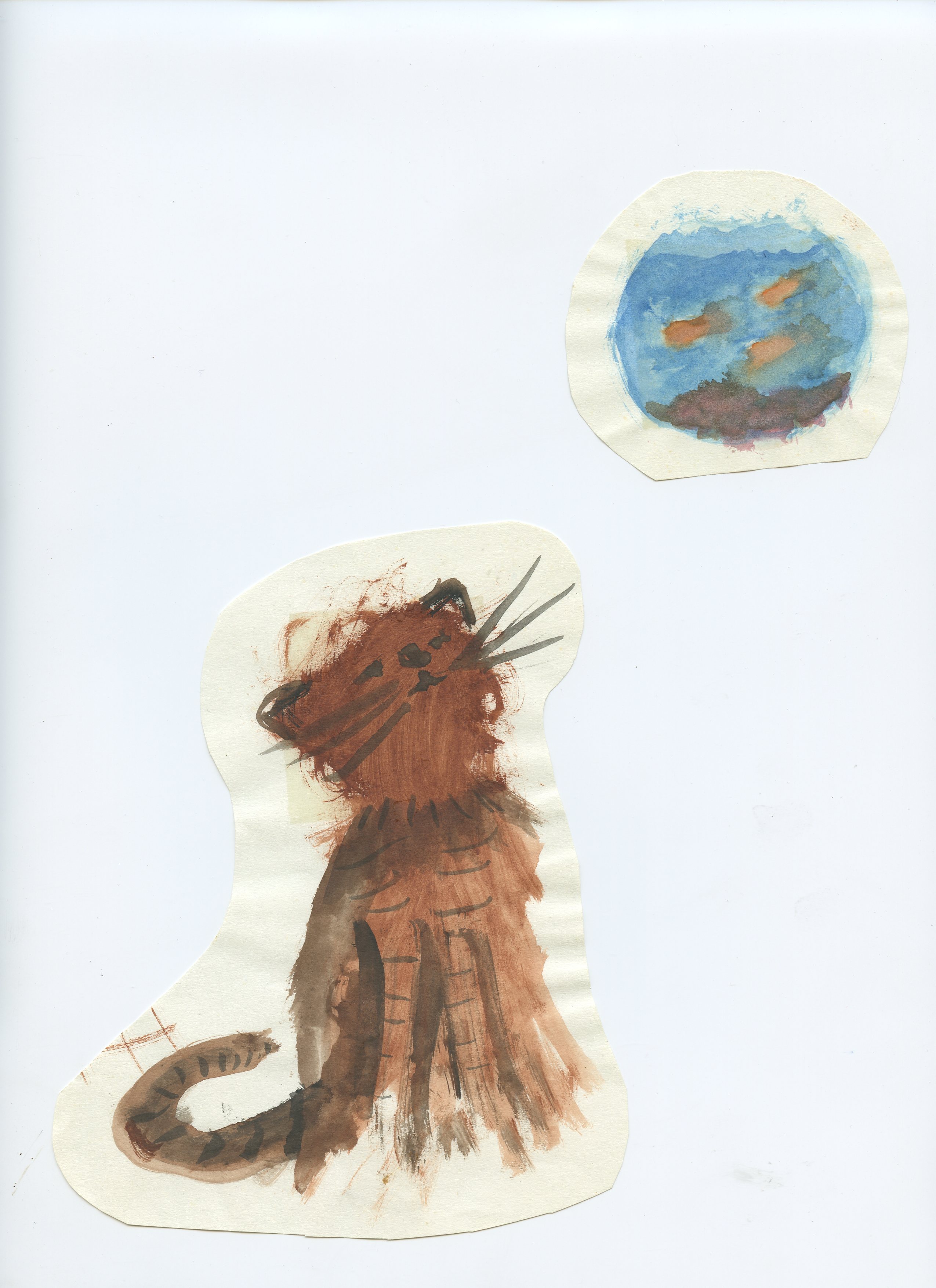
If your cat requires entertainment and Animal Planet does not capture its attention, you can always get a fish.

If your cat requires entertainment and Animal Planet does not capture its attention, you can always get a fish. This is a watercolor I did in my late 20s. I’d like to offer this design on a T-shirt.

I’m in mourning for my cat right now. Algernon was geriatric at 17, and he suffered from a rare slow-moving cancer called multiple myeloma, and, at the end he was deaf, and blind, and incontinent, but he was the best cat, absolutely full of devoted love. In fact, he was my husband’s cat, and had been since he was young. My husband had Algernon before he met his first wife, but once we moved in together, the cat decided to love me best. He would purr so loudly you could hear him from twenty feet away whenever I walked into the room. He used to sleep next to my head (he had his own pillow) and purr into my ear when I had a headache, and he would head butt me repeatedly if he didn’t get enough pets. He was also prone to tender love bites.

Fast cat

Fast cat

I can’t find the sketch I want to include here, of my friend’s imperious cat, Suna. I know it’s around somewhere, because it’s one of the nicest cat sketches I’ve ever done. Possibly, I gave the picture to my friend. Instead, here is a super-fast drawing I did on the Wacom tablet in a minute or two. I was trying to look at the proportions of a child’s body, and the cat was a convenient way in.

Another fast cat

Another fast cat

Cats make terrible subjects. While they may lie, unmoving, for hours a day, the second you try to sketch one, it will move. You have about fifteen seconds to limn a cat before it changes poses.

I miss him a lot. You were a good cat, Algernon.

I miss him a lot. You were a good cat, Algernon.


Words Fail

Screen Shot 2014-06-19 at 3.56.04 PM


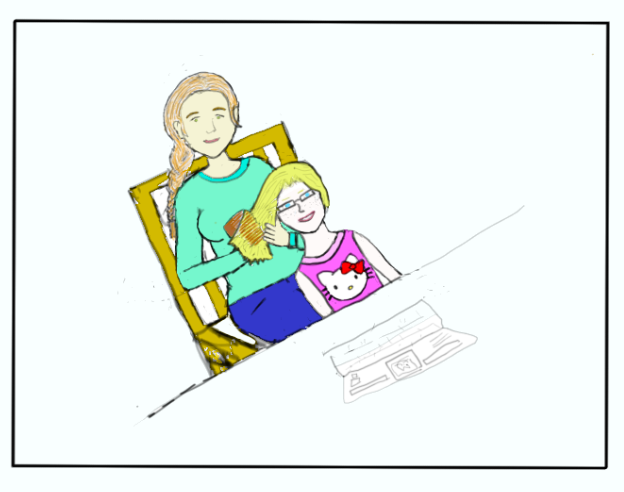
This is among the first drawings I did on the Wacom Tablet: rough, but effective. There’s me—I can draw a fairly decent cartoon representation of myself, or a representation of what I picture as my best self—and there’s my stepdaughter getting her hair combed before bed, smiling because I’m showing her a funny cat video on YouTube. Working from a photograph would probably render better results, but this is drawn from memory, ninety minutes after she went to sleep. It’s flat; the proportions are off. I must live with my faulty perception, and my unpolished ability.

As may be apparent to readers, I’ve never had an art lesson in my life, save for grade school and camp curricula, and a couple semesters of pottery. What I have studied, extensively, to abstraction, to the exclusion of vast swaths of normal human existence, is writing. I have toiled well over my ten thousand hours to mastery. I have taken ten Iowa-style fiction workshops. I have taken craft classes. I have studied with acclaimed writers, and considered their feedback, received their approval. I have organized my own workshops, created circles of writers who read and critique each other’s writing. I have revised and revised and revised.

I could describe for you, in broad brushstrokes or pointillist detail, the way the light plays on my stepdaughter’s hair, how the blond strands glow with natural rivers of platinum and strawberry, the way the tangles of her youthful athleticism smooth out into silky sheets of gold under the thick teeth of my wooden comb. I could show you the surface: the cinnamon freckles blooming across pink cheeks, the cool ice of her sparkling blue eyes. I could show you the hidden details: the wine-colored birthmark just under her hairline at the nape of her neck, the cracked white leather places between her fingers where her skin at times dries out so completely that blood seeps from the gaps. I could write a book about her: the way she chatters about cartoons no one else has seen, the way she hold her nose not only when she jumps into the pool, but also when she swims, one-handed, beneath the water.

The image is what it is.

All my life, my writing has been characterized as remarkably good. Qualified writers who have achieved recognition in their art have told me that I write well. I have sold a couple short stories. In the corporate world I have supported myself solely through this craft since I finished my MFA, ten years ago, but publishing four short stories in a decade while writing web content at $100 an hour is not quite the same as selling a novel.

I cannot sell a goddamn novel. Another successful writer, a close friend, suggests I don’t submit enough, and so I polish my queries and hurl them out in the universe. Some agents, some publishing houses, can’t afford the courtesy of a rejection note. Most are kind enough to offer the form rejection. Occasionally, an agent will ask for some piece of a manuscript before rejecting me. Whenever I get a little traction, the dream gets pulled out from under my feet. My work is not viable, or commercial, or accessible, or whatever it is they seek.

Originally I considered calling this blog “Words Fail,” which I’ve kept as a tagline. Words fail, but not because of my ability. With modesty and humility, I can state that I probably write in the objective ninety-ninth percentile of people on the planet. But that is not, apparently, good enough.

And here I’ve decided to share my infant scribbles, little amusements in which I’ve invested one fraction of one percent of the effort that I’ve put into ten novels, two full-length stage plays, and countless short stories, and already, before I’ve even officially launched my brand or shared this URL with friends and family, people seem interested in what I’m trying to do.

My drawings only hint at their intentions; I can only polish them up to the point where my ability falters, while I’ve acquired the ability to burnish my writing to a fine, mirror-like glow. But words fail.