Tag Archives: comic

Taking Care of the O’Learys

waoa 13 taking care of the olearys_edited-1

Mental illness doesn’t run in the family so much as it line dances there.

I find “Taking Care of the O’Learys,” achingly beautiful, in the way that audiences are taught to look at life while watching Our Town, except with moldy potato water buckets and inebriated bondage. Barb could leave—other women might, like the wife in “The Yardman,” —but she has a moment in which she’s wholly open to love, and in letting it in, she understands that it’s paired inextricably with the general weirdness she’s been resisting, and that it’s not just doable, it’s actually wonderful. The madness isn’t anywhere near the worst thing that could happen. Losing your family is the worst possible thing. She wouldn’t really leave anyway. She’s the kind of person who keeps washing the floor even though she knows she’s done her utmost and it needs to be replaced. But she did need to be reminded of how much they loved her. It’s a happy ending with madness.

To heighten the implied creepiness and Barb’s sense of terror of the first part of the story, I decided to flip black and white, and only use a very few colors. Probably the colored parts will look less awesome in print form but they looks amazing online: blue tarp, green mold, red, orange, and yellow fire. Quite pleased with this one.

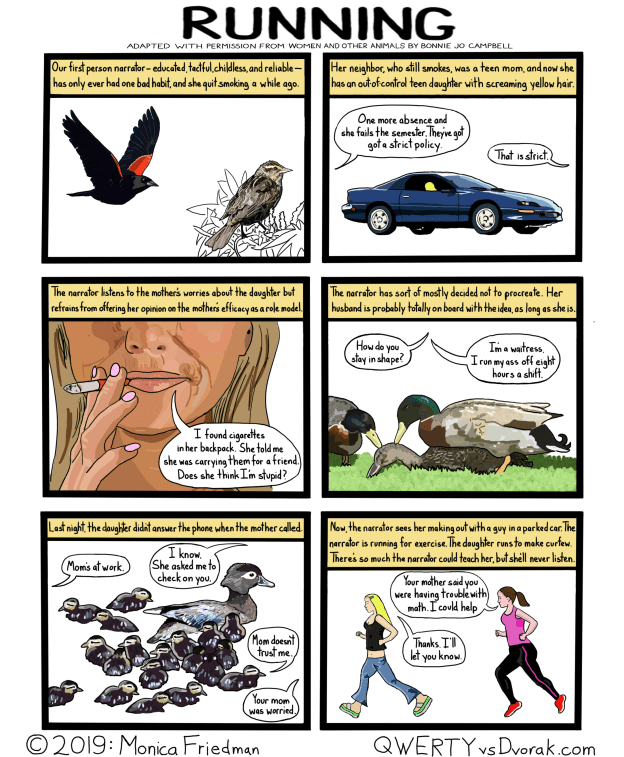
Running

waoa 12 running_edited-2

I miss those ’90s flare low rise jeans, but I don’t miss belly shirts.

To me, “Running,” feels like the precursor to “Daughters of the Animal Kingdom,” with its discussion of motherhood versus not-motherhood and its frequent reference to animals. “Running” is rife with birds, and I could have drawn a bird in every panel, as I drew only animals in “Daughters of the Animal Kingdom,” but I got hung up on the part of the story that describes the pattern of a male wood duck as looking like a map of the world, because I kept looking at photos of male wood ducks and couldn’t see a map of the world in there. Plus, I really liked the juxtaposition of the prematurely aged mom smoking a cigarette while complaining about her daughter smoking cigarettes.

I also enjoyed drawing the redwing blackbird. Male redwing blackbirds are super territorial and will attack anything that remotely resembles another male redwing blackbird. My mother has a story about one attacking the head of my black-haired brother when he was little. As for panel 4: ducks are jerks. Duck rape is a thing. As for panel 5: I couldn’t fit many more baby ducks in there. I wanted to draw 40. In the last panel, I tried to illustrate the good form/bad form the narrator talks about in reference to running.

The Perfect Lawn

waoa 8 the perfect lawn_edited-1

Hope springs eternal, especially when you’re optimistic and delusional.

This kid is great, so thoroughly convinced of ideas that are so patently false, so willing to act on those beliefs. He sees the couch in the basement catch fire, and his instinct is to run to the bedroom on the first floor and carry a girl out of the house. And this is after she warned him to stop following her. She refuses to eat in her own house if he’s there, and he still thinks that she’s going to marry him if he just keeps kissing up to her mom.

And the girl: all she can think about it getting away from him, from her mom, from that house, from that town. She’s destined for urbane sophistication, she just knows she is, and all of this is beneath her. Otherwise, she’d be more worried about this crazy, obsessive kid.

The mom is special. I considered drawing her and Kevin making out in Madeline’s bed (omg yes) for the last panel, but the smoldering cigarette is such a big image in this story and I wanted to give it more air time.

If you can, you have to zoom in on the first panel. I drove myself crazy trying to draw the house, the kids, the mom, and the girl all in one panel and it looks tremendous up close, but it’s perhaps a bit jumbled when you shrink it down.

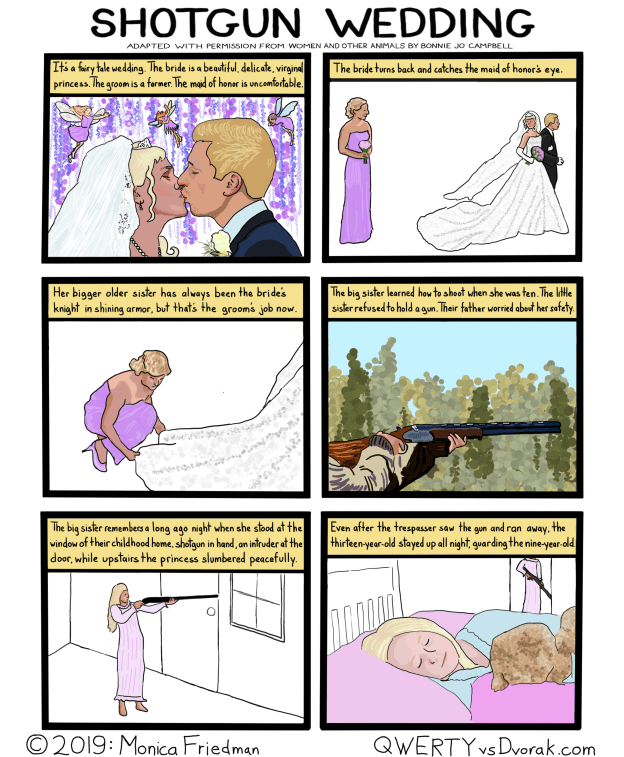
Shotgun Wedding

waoa 6 shotgun wedding_edited-1.png

Well, if this isn’t the most gendered thing I’ve ever drawn…

“Shotgun Wedding” is a pure example of flash fiction, not just due to its length, but to its form. It’s the story of a single moment of revelation, which, in my view, is the point of a flash. It reduces a story down to the climax, takes a massive web of understanding and compresses it into a tiny dot: this moment, in which one person has to let go of another.

The love between the sisters, and particularly of the big sister, who is the first person narrator, for her more vulnerable sibling, is really beautiful. The little sister is both the embodiment of feminine perfection but also the odd girl out in the family, too magical and delicate to exist in the world where everyone else lives. She’s balanced by the strength of her sister’s determination, and the sense of responsibility the narrator has always felt to protect her like a precious treasure. In the space of the story, the dynamic has just ended. The little sister has her husband as a counterweight now, but the big sister is going to be reeling backward, as you do when you’re pulling hard at something that suddenly gives way.

But time, to my way of thinking, is infinite in both directions. The moment in which the big sister was a teenager standing at the window with a shotgun protecting her family will always exist, as will this present moment of release.

There’s a fun balance in the pinky-pinkiness of the little sister’s world and the metallic shotguns of the big sister’s. It was challenging but entertaining to draw. Took me forever to get the little sister looking over her shoulder right.

Eating Aunt Victoria

waoa 5 eating aunt victoria_edited-2

Oh, naugahyde. I mean, who doesn’t love sticking to their living room furniture?

This is the exact sort of short fiction I live for. It’s bizarre and serious, funny and terrible. Although she’s 18 and the piece is written in 3rd person, Bess is essentially an unreliable child narrator, since we experience the action through her biased perspective, which shifts suddenly as she realizes that Aunt Victoria is a human being with powerful emotions, some of which involve her, and that she and her brother are 2 separate people. She’s not joined at the hip to him, or to the house where they grew up. The text says “Hal was releasing her into the universe,” but really, she’s releasing herself. She just craves Hal’s confirmation that she exists as autonomous entity, just as Hal needs Bess to accept him as a gay man.

In this story, Bess has 3 connections to her dead mother: her living brother, her stepmom, and her house, and it’s no coincidence that the house is crumbling around them. Hal is drifting away (car, school, boyfriend) and Victoria is clearly never moving on (hence, she’s literally stuck inside the porch), so Bess has to choose to move on or remain stuck.

There’s a meanness to the kids’ understanding of Aunt Victoria, where fat-shaming stands in for their own confusion and anger about their mother’s lesbianism, her death, and their lives since they lost her. I think it’s easy enough to read the text in such a way that you understand food is a substitute for love in this family. Bess and Hal haven’t had enough since their mom died, despite Aunt Victoria attempting to provide for them. (But they don’t want her one-step-removed restaurant leftover love; Hal adopts a sour grapes attitude and tells himself gas station junk is all he needs, but Bess misses meals and wishes someone would offer one to her, something that’s just for her.) Aunt Victoria, despite her locked cabinets of treats, can never find satisfaction: her lover is gone and she didn’t know how to inspire affection in the children (so it doesn’t matter how much food she hoards; she’ll never satisfy the need for what she’s lost). Undoubtedly, she’s still depressed, possibly more broken than the kids over her partner’s passing. Presumably, the story’s end is a turning point in this family, and, in lovingly taking care of Aunt Victoria before moving on to their own timelines, they can heal all the wounds left by their mother’s death.

As always, I had to cut some good parts of the story to fit the comic in 6 boxes. In this case, that meant excising the arc about Bess’s own sexuality. She fears being a lesbian, she fears being a virgin, she fears being alone. Her desperation to keep up with her older brother sexually leads her to one of literature’s greatest cringe-worthy seduction fails. She’s literally so unprepared to enter this phase of life that her come-on scares off an 18-year-old guy who’s already agreed to sex. This is where having a mother to advise her about relationships (and to put her brother’s sexuality in perspective) would have come in handy. Presumably, she’s going to learn a lot in the Navy. Presumably, they’ll set her straight (so to speak) and offer her everything she needs.

 

Gorilla Girl

waoi 3 gorilla girl_edited-1

Civilization is overrated.

“Gorilla Girl,” raw with emotion and rich with meaning, offers a protagonist who may consider herself a member of the animal kingdom, but is a great deal more self-aware than a lot of Bonnie Jo Campbell’s characters. She knows, at least, who she is and what she wants to do, and she recognizes opportunities when they arise and seizes upon them.

I’ve read this story many times in the last 15 years and I can’t believe that only as I found myself stuck on how to present the scenes at the circus did I see the parallels to Steppenwolf by Hermann Hesse, a book that had a profound influence on me as a young adult. Of course, Harry Haller, as a young man, has voluntary ties to his middle class upbringing and is torn between his 2 natures. Our Gorilla Girl, young and without male privilege, is moderately tied to convention by love of her mother but primarily by the lack of mobility and freedom offered to young girls. Her crisis may be less pronounced due to her temporal environment, but more pronounced due to her gender. Her struggle is not whether to give the beast reign or to settle down in a comfortable bourgeoisie existence, but only when and where to give the beast reign.

My first thought in tackling this story was to highlight my immediate reaction that it should be read as a universal tale of female rage, that all Americans socialized female contain within themselves this exact anger, the despair at being restricted by virtue of gender, the sense of alienation by an oppressive civilization that imposes a dull domesticity on a vibrant animal nature, but then I’m not sure if that’s me projecting. Clearly, not all women bristle against the edict to be beautiful and well-groomed and mannerly and acceptable/approachable. Some of them seem happy to become the thing my mother so desperately wanted for me, the thing that neither I nor the protagonist could hope to emulate, let alone assimilate. After Jill from “Boar Taint,” Gorilla Girl is the Bonnie Jo Campbell character with whom I most relate, although I have found other—ahem—outlets for my animal nature and made a truce with objective reality. I leave it to the reader to choose: is Gorilla Girl an anomaly, a freak who can only thrive in the carnival, or is she ubiquitous, an expression that all women carry with varying degrees of comfort and ease?

Rhyme Game

waoi 1 rhyme game 1

Any time you get to draw a corvid is a good time.

For such a short story, “Rhyme Game” took forever to work through. The script, at least, took 3 days to finish. Despite the length of the story, I still had to cut out some interesting pieces, particularly the trash compactor and the butchering of the frozen cow. However, I managed to keep 100 percent of the actual dialog.

Tinny Marie’s mom, like so many of Bonnie Jo’s moms, seems stretched thin, working harder than most people could imagine to take care of her family but, at the same time, and not as concerned with her child’s welfare as the child thinks she should be. Flawed, like so many of the characters in these stories. She seems distracted, but she keeps playing this rhyming game with Tinny Marie.

Tinny Marie is a strange name to me.

Tinny Marie’s mom is nothing like my mom, who would have had a conniption if child-me had made the slightest reference to having a beer. She would not have thought that an acceptable rhyme.

Circus Matinee

waoa 1 circus matinee_edited-1

Her hair is meant to be “lightning struck,” which is possibly up for interpretation. This is how I interpreted it. 

Flipping back through the previous 2 volumes of Bonnie Jo Campbell comics, I was struck by something Bonnie said in conclusion, that she wrote her stories to inspire compassion in readers, to make them care about the marginalized folks that she most often writes about. She wants her characters to be seen, especially those types of characters who we often don’t really see.

Big Joanie is the kind of person that it’s easy not to see clearly, to dismiss for being big and fat and ugly, with bad skin and bad hair, and in the case of most of the men in this story, to sexually objectify because, not in spite, of her lack of conventional attractiveness. “Circus Matinee” puts us inside of Big Joanie’s head, where we can see her being overlooked and objectified and we get to see her reaction to it. She’s used to it. She accepts it. She anticipates it.

But also, because it’s all she’s ever known, it’s all she ever expects.

This is the story of a moment. The tiger is out of its box, and now, so is Big Joanie. In that moment, she chooses not to obey, not to remain sightless as she has been made in the past, as the hapless, sexually objectified mistress in the cheap seats remains in the moment. Big Joanie says “fuck you” to men who tell her what to do and what to see. When Big Joanie chooses to see, the reader can’t not see her. We’re cheering for her.

The tiger and the snow cone pictures came out pretty well. The feet in panel 2 remind me of drawing Carl Betcher’s feet in “Multitude of Sins” from Mothers, Tell Your Daughters. I felt gross about drawing young Big Joanie in panel 5; in my first draft she was fully dressed, but that doesn’t reflect the text and doesn’t make sense. I left her the one pant leg, small comfort. Big Joanie’s face is based off the actress Dot Marie Jones, who always turns in the kind of performance that does make you look, and see. The adulterous businessman in panel 4’s face is based off convicted felon and poster boy for casual evil Martin Shkreli.

We can dream, can’t we?

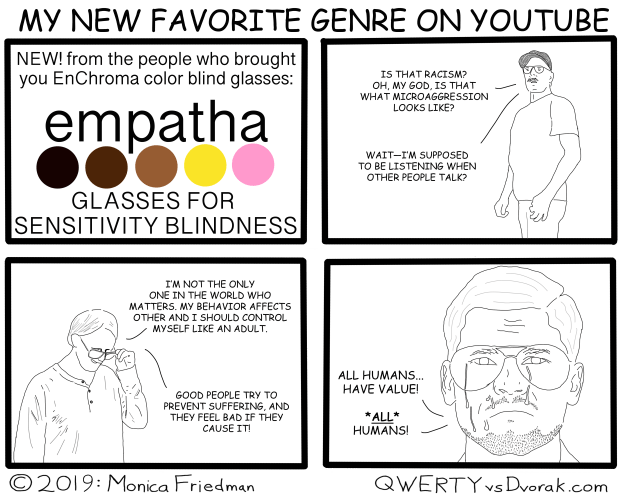
empatha_edited-2

I care. Fight me.

I wrote this comic on October 8, shortly before my life got very, very hectic. Things have been weird. Comics lacked urgency. This script seems to have aged well, though.

So, yeah, I love those videos where some tough old dude puts on a pair of EnChroma glasses and then starts crying at things being purple. If only it were that easy.

A couple people encouraged me to get back to comics recently. I’ll be presenting a paper about my Bonnie Jo Campbell comic books at the Society for the Study of Midwestern Literature’s annual symposium this spring, and BJC suggested I try to get Women and Other Animals out in time for that! Finally, I can collect them all.

November 1

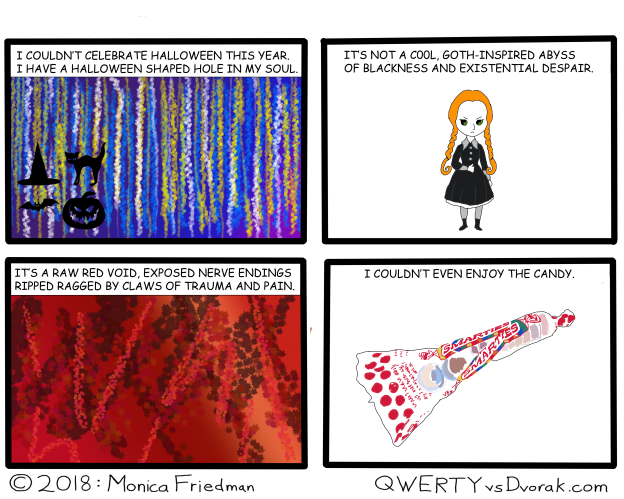
no halloween

We could have this stuff 5 days a week, what do you think?

No, I don’t want to talk about it. Unless you think you’ve got something to say to me.

I know that a lot of people think Smarties are gross. I used to think I liked them. Tonight I didn’t even want the good chocolate.

On the plus side, I’m a finalist in a writing contest. If you want to cheer me up, you could vote for me. You can check out the complete list of finalists and all the entries here.